
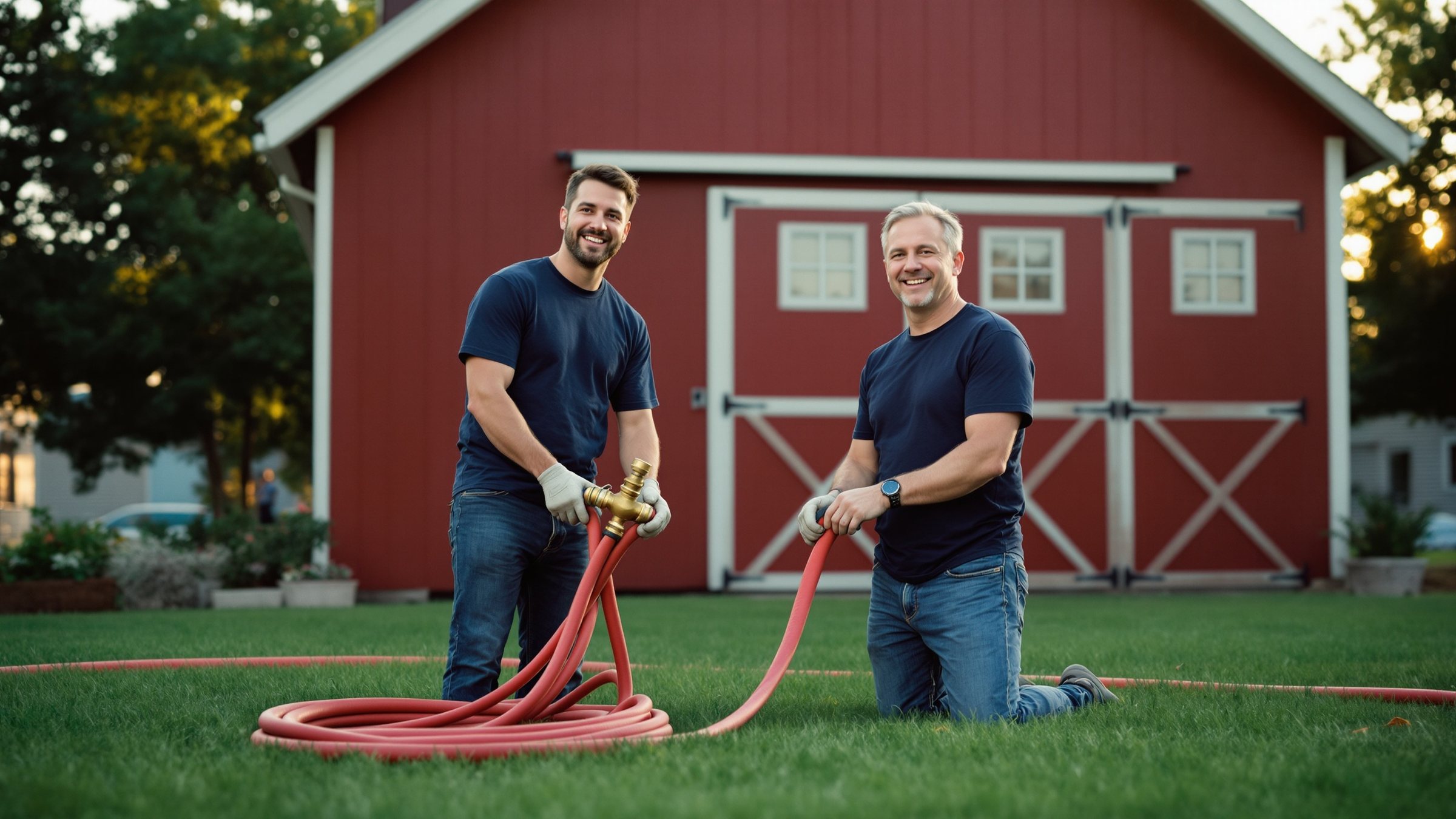
The pager goes off during Sunday lunch. Minutes later your neighbor is on the fire engine, the same guy you chat with over the garden fence.
Volunteer fire departments in the USA: where the neighbors fight the fires
Part of the guide Freedom in the USA: what it means in law and in everyday life
In rural America, the fire department is not a government office but a club of neighbors. Of the more than 27,000 fire departments in the national registry, 70 percent are all-volunteer and another 15.5 percent mostly volunteer. For many Europeans this is a familiar idea, and it is one of the fastest ways to feel at home in an American town.
Live next to the fire station in a small American town and you soon learn its rhythm. On Tuesday evening the bay door is open, men and women in work pants are washing the engine, someone is grilling and kids are climbing on the running boards. On Saturday there is a pancake breakfast to raise money for equipment. And when the siren sounds at night, your neighbor jumps in his pickup and drives off. This is not folklore. It is how a large part of America organizes its fire protection.
Many Europeans will know the idea, because back home volunteers run the fire service in plenty of villages and small towns too. In America there is one thing worth knowing: the fire department is often not part of the town but a separate association or a separate district with its own tax. This guide shows how volunteer fire departments in the USA are organized, who pays for them and what you need to know as a newcomer who wants to join, using Texas as the example.
1The numbers: a nation of volunteers
The U.S. Fire Administration, a federal agency, keeps a national registry of fire departments. Registration is voluntary, but by its own account the registry covers about 92 percent of all departments. In early 2024 it listed 27,166 fire departments. Of these, 70 percent were all-volunteer, with not a single career firefighter. Another 15.5 percent were mostly volunteer, meaning no more than half career staff. Only 9.5 percent were all-career departments.
The people tell a similar story. The registered departments count 1,058,800 active firefighters. Of these, 52.6 percent were volunteers, 12.6 percent were paid per call and 34.8 percent were career firefighters. Just over two thirds of departments have a single station, and together the registered departments run 52,309 stations. Almost all of them, 96 percent, are local fire departments and fire districts; the rest are tribal, state and federal departments, industrial and airport fire brigades. The largest share of departments is in the South, at 35.6 percent, followed by the Midwest.
| Metric | Value |
|---|---|
| Registered fire departments | 27,166 (about 92 percent of estimated departments) |
| All-volunteer | 70.0 percent |
| Mostly volunteer | 15.5 percent |
| Mostly and all-career | 5.0 and 9.5 percent |
| Active firefighters | 1,058,800, of whom 52.6 percent volunteer, 12.6 percent paid per call, 34.8 percent career |
| Departments with a single station | 67.8 percent |
Source: U.S. Fire Administration, National Fire Department Registry Summary, January 2024. The registry is voluntary; the estimate of 29,452 fire departments comes from the NFPA for 2020. Accessed October 24, 2026.
2Where the neighbors fight the fires
The shares vary widely from state to state. In Pennsylvania and New York about 90 percent of departments are all-volunteer, in North Dakota, South Dakota and Nebraska more than 91 percent. In Florida, California and Arizona it is only about a third; there, career and combination departments together make up the majority.
Texas sits close to the national average. Of the 1,520 registered Texas departments, 69.9 percent are all-volunteer and 11.7 percent mostly volunteer. Together that is more than eight in ten departments where volunteers are the majority. So if you move from Europe to Texas ranch country, chances are good that your fire department is made up of your neighbors.
| State | Registered departments | All-volunteer | Mostly volunteer | All-career |
|---|---|---|---|---|
| Texas | 1.520 | 69,9 % | 11,7 % | 11,6 % |
| Florida | 462 | 34,6 % | 10,8 % | 39,0 % |
| Tennessee | 638 | 73,7 % | 13,2 % | 8,3 % |
| Pennsylvania | 1.804 | 90,0 % | 6,7 % | 2,6 % |
| New York | 1.660 | 90,6 % | 3,5 % | 4,2 % |
| California | 849 | 28,7 % | 25,9 % | 29,8 % |
| Arizona | 238 | 30,6 % | 23,0 % | 31,5 % |
| USA total | 27.166 | 70,0 % | 15,5 % | 9,5 % |
Source: U.S. Fire Administration, National Fire Department Registry Summary, January 2024, tables 1 and 2. Accessed October 24, 2026.
3How a volunteer fire department is organized
Texas law defines the volunteer fire department precisely. Under § 614,101 of the Government Code, it is a fire department operated by its members and run on a not-for-profit basis, including departments exempt from federal tax as nonprofit organizations. A department with up to 20 paid staff still counts as volunteer. The registry's national categories follow the definitions of the NFPA, America's major fire protection standards organization: all-volunteer means no career staff, mostly volunteer up to half, mostly career more than half.
So at heart, many departments are associations sustained by their own members. And in America, fire protection and emergency medical services often go together: the Census Bureau explicitly lists fire and EMS as functions of many new special districts.
One feature that surprises newcomers is the pension. Texas has its own state pension fund for firefighters and emergency responders, the Texas Emergency Services Retirement System. A department can choose to participate. Then, under § 862,002 of the Government Code, anyone who performs emergency or support services for it as a volunteer or employee becomes a member, whether paid or not. Exceptions include people under 18 and members without the required certification of physical fitness.
In writing: which visa fits you and your family, prepared with the immigration attorney on the firm's team.
4Who pays for the fire department
A fire engine costs more than a pancake breakfast brings in. So in Texas the money comes from several sources. The most important is often the Emergency Services District, or ESD, a separate district for fire and EMS under Chapter 775 of the Health and Safety Code. An ESD is created from the ground up: at least 100 voters who own land in the proposed district file a petition with the County Judge, or a majority of them if there are fewer than 100. The Commissioners Court holds a hearing where anyone interested may speak for or against. If it grants the petition, an election confirms the district and its tax.
From then on, the ESD levies an annual property tax in the district, collected on its behalf by the county tax office. If the board wants to raise the maximum allowed tax rate, it needs another election. The five-member board is usually appointed by the Commissioners Court; only in certain counties specifically named in the law is it elected. To serve on an appointed board, the law requires you to be at least 18, a citizen residing in the state, and either a registered voter in the district or the owner of taxable land there.
Then there is the state. Texas A&M Forest Service, the state forestry agency, supports volunteer departments and small combination departments with no more than 20 paid staff. Its Rural Volunteer Fire Department Assistance Program provides cost-share funding for vehicles, rescue equipment, protective gear, dry hydrants and training. Other programs reimburse insurance such as firefighters' accident coverage, offer affordable liability cover for emergency vehicles, pass on donated equipment and hand over surplus military and federal equipment to departments.
5Joining as a newcomer
How you become a member is up to each department, under its own rules and those of its state; ask them about admission, training and medical checks. In Texas, membership in the state pension fund requires a certification of physical fitness. In Florida, the law provides a dedicated certificate for volunteers, the Volunteer Firefighter Certificate of Completion, issued by the state fire authority after a required course.
For immigrants there is one more question that no department can answer for you. Many departments pay nothing, but some pay per call or offer a stipend. Whether such a payment is compatible with your immigration status depends on your visa. If you are in the USA on a visa that ties you to a specific employer or company, clarify this before you join. If you have a green card, you don't need to worry about it.
One more practical tip: don't start with breathing apparatus. Ask about roles that keep you out of the fire, such as radio, the treasury, events or looking after the station. That counts too: the Texas pension fund explicitly recognizes support services alongside emergency response. Start this way and you will get to know the town faster than at any reception.
6From volunteer to career: the Florida example
Florida shows how a state both separates and connects volunteers and career firefighters. Under § 633,408 of the Florida Statutes, the state's fire division sets its own courses: a minimum standards course for the Firefighter Certificate of Compliance that career firefighters need, and a course for the volunteers' Volunteer Firefighter Certificate of Completion. Both paths include training on cancer and mental health risks in the fire service, with prevention and treatment. On top of that come continuing education courses for both groups.
To become a career firefighter, § 633,412 requires a high school diploma or equivalent and a minimum age of 18. You must have no conviction for a felony or certain misdemeanors, submit fingerprints for an FBI background check and prove your physical fitness through a medical exam. You must pass the minimum standards exam within twelve months of the course. If you have equivalent training from another state, you can have it recognized. For many, the road into the profession starts exactly like this: as a volunteer in their own town's department.
Visa, bank account, taxes and where to live: your move with Mount Bonnell Advisors.
7When fire strikes: burn bans and drought
Live in rural Texas and you learn that fire protection doesn't start with the engine. In a drought, the county's Commissioners Court can ban or restrict outdoor burning in the areas outside city limits. The legal basis is Section 352,081 of the Local Government Code. Whether a drought exists is determined by the Texas A&M Forest Service at the county's request, using a drought index, and it also reports when the drought is over. The Commissioners Court can also issue a ban for other reasons if conditions in the county pose a danger.
For you as a landowner, that means: if you want to burn brush, branches or trash, check first whether a ban is in effect in your county. And if something does catch fire, in many areas it's the same department that invited you to breakfast on Saturday that shows up.
8Volunteering beyond the fire department
The fire department is the most visible volunteer role in small-town America, but not the only one. The hunter education courses that many hunters in Texas need before they can hunt are taught by volunteers, as the wildlife agency TPWD explicitly states. School boards, churches, sports clubs and the county fair all run on people who keep going after work. How hunting is organized in Texas is covered in our guide Hunting License USA, and how counties, cities and districts work together in the guide County, City, School District.
Many Americans call this community, and they mean something very concrete: the certainty that someone will come when you call. If you come from Europe and pitch in, you belong quickly. What else small-town life looks like is covered in the guide Living in a Small American Town and the article Small Town USA; for the big picture, see the overview Freedom in the USA.
- Of the 27,166 fire departments in the U.S. Fire Administration registry, 70 percent are all-volunteer and 15.5 percent mostly volunteer; more than half of all active firefighters are volunteers.
- In Texas, 69.9 percent of the 1,520 registered departments are all-volunteer; many are nonprofits run by their own members.
- Funding often comes from an Emergency Services District, which landowners request by petition and voters confirm at the ballot box, plus programs from the Texas A&M Forest Service.
- In Texas, volunteers at participating departments are members of a state pension fund for emergency responders, even if they earn nothing.
- If you're in the US on a visa and join a department that pays per call, check first whether that's compatible with your status.
How we help you
- Visa RoadmapIn writing: which visa fits you and your family, prepared with the immigration attorney on the firm's team.
- Moving to the USAVisa, bank account, taxes and where to live: your move with Mount Bonnell Advisors.
- Visa and Green Card ConsultationWhich route to the USA fits you, settled in one conversation.
More on Freedom & Home
All articles → Counties in the USA: what your county decides for local life Read more →
 Small Town USA Read more →
 Freedom in the USA: what it means in law and in everyday life Read more →
 Why I am no longer a conservative Read more →
 Homeschooling in the USA Read more →
 Corporatism is not the free market Read more →