
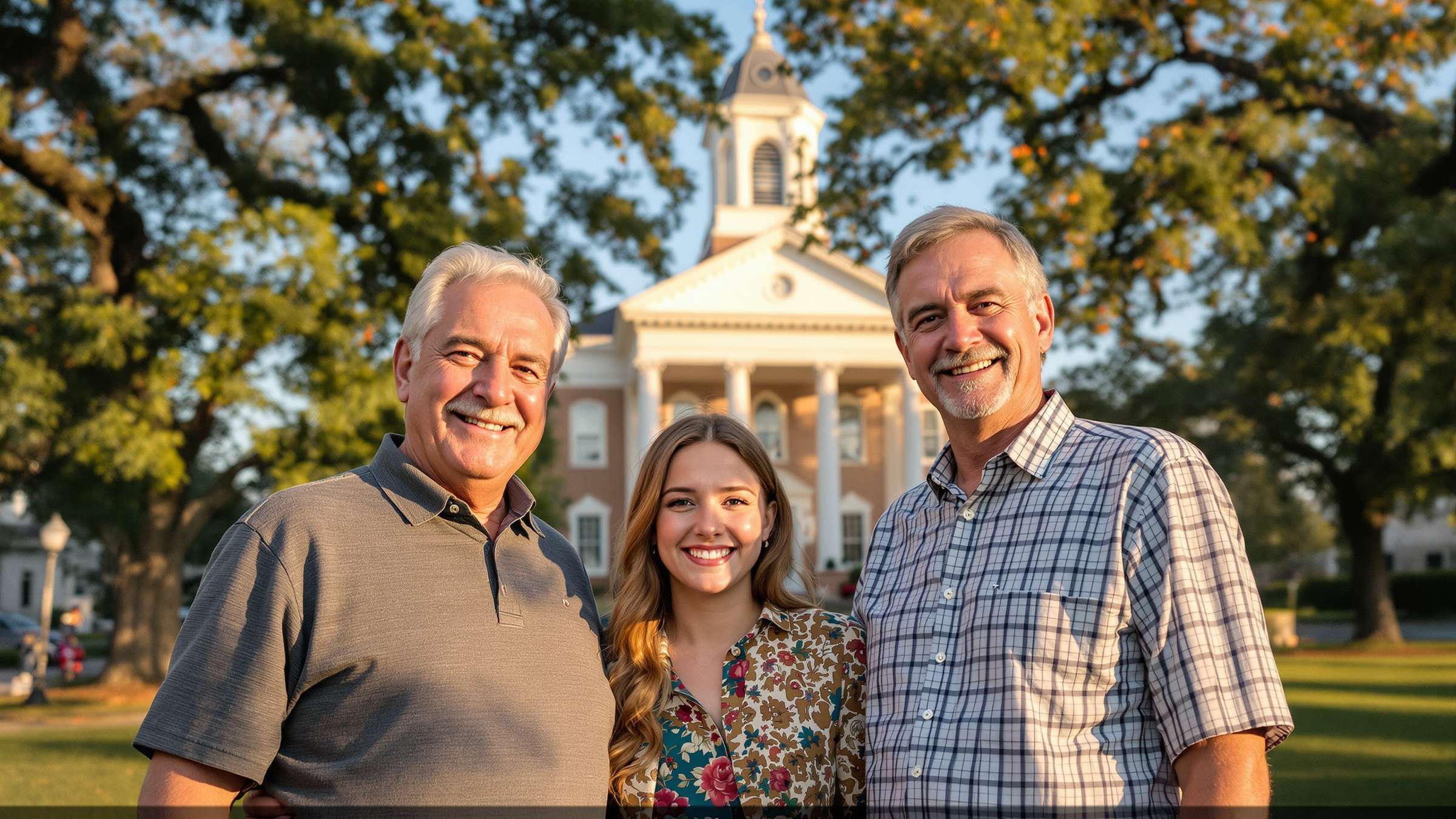
The sheriff, the judge and the school board are all on your ballot. Welcome to America's smallest capital.
Counties in the USA: what your county runs in your daily life
Part of the guide Freedom in the USA: what it means in law and in everyday life
A county is roughly what a county or district is back home in Europe, just with more elections. Below the state, more than 90,000 local governments shape everyday life: counties, cities, townships, school districts and districts for single tasks such as water or fire protection. Move to America and you will deal with several of them, often from your very first month.
Sometime in your first month in Texas, you will be standing at the counter of your county tax office registering your car. It feels odd at first, but it makes perfect sense. In much of America, the county is the government you see most often: it collects property tax, runs the jail, provides the sheriff and decides during a drought whether you may burn brush.
Coming from Europe, you look for a comparison and land on your own county, district or municipality. That roughly fits. The difference is how this level is governed: in America, citizens elect not just a council but often the sheriff, the judge, the prosecutor and the tax collector too. This guide explains what a county is, who decides what, and how it works alongside cities, school districts and special districts.
1What a county is
According to the Census Bureau, counties are the primary legal subdivisions of most states, and most are functioning governments in their own right. Each state decides what they may do and how they are organized. In Louisiana they are called parishes; in Alaska, boroughs and census areas defined by the state fill the role. Maryland, Missouri, Nevada and Virginia have cities that belong to no county; the Census Bureau treats them as county equivalents. The District of Columbia has no such subdivisions.
How many counties there are depends on who is counting. The Census Bureau counts 3,031 county governments, meaning only counties with a government of their own. NACo, the national association of counties, speaks of 3,069 counties, parishes and boroughs. The history runs deep: according to NACo, the first county governments appeared in 1634 on Virginia's eastern shore, modeled on the English shires.
Texas has 254 counties. According to the Comptroller, they range from more than four million residents in Harris County to just over a hundred in Loving County on the New Mexico border. That range explains a lot. A county may govern a metropolis of millions or a handful of ranches with a single courthouse.
2More than 90,000 local governments
The county is just one of five types of local government the Census Bureau distinguishes. The others are cities and towns (municipalities), townships, school districts and special districts. In 2022 the Census Bureau counted exactly 90,837 local governments; by 2025 there were 91,438. The number is rising mainly because new special districts have been created in four states: Colorado, Florida, Nebraska and Texas. Many of the new districts handle several tasks at once, such as community development, water, or fire and emergency services.
3Who runs a county
In Texas, the constitution sets the structure. Every county is divided into four commissioners precincts, and in each one voters elect a county commissioner for four years. Together with the county judge, these four form the commissioners court. The name is misleading: the body is not a court but something like a county council and county administration rolled into one. It exercises the powers over all county business that the constitution and laws grant it. The county judge is also elected for four years and presides over both the commissioners court and the county court, a court with its own jurisdiction.
Texans in every county also elect a sheriff for four years and, where no criminal district attorney has jurisdiction, a county attorney who represents the state in court. In the county's precincts, justices of the peace and constables are elected as well. If the sheriff's office falls vacant, the commissioners court fills it until the next election.
In Florida, the constitution requires every county to elect a sheriff, a tax collector, a property appraiser, a supervisor of elections and a clerk of the court, each for four years. No county charter may abolish these offices, transfer their duties, change their terms or fill them other than by election. The county is governed by a board of county commissioners with five or seven members. A county can adopt its own charter by popular vote. Nationwide, NACo counts more than 19,350 elected county officials and members of county governing boards. Why Americans fill so many offices themselves is explained in the guide Elected, not appointed.
| Office | Texas | Florida |
|---|---|---|
| County leadership | Commissioners court: county judge presiding plus four county commissioners, four years each | Board of county commissioners with five or seven members, staggered four-year terms unless the charter provides otherwise |
| Sheriff | elected, four years | elected, four years; no charter may abolish the office |
| Prosecution | County attorney elected for four years where no criminal district attorney has jurisdiction | |
| Other elected offices | Justices of the peace and constables in the precincts | Tax collector, property appraiser, supervisor of elections, clerk of the court, four years each |
| School district | Board of trustees, elected for three or four years |
Source: Texas Constitution Art. 5 §§ 15, 18, 21, 23; Texas Education Code § 11,059; Florida Constitution Art. VIII § 1(d), (e). Accessed October 24, 2026.
In writing: which visa fits you and your family, prepared with the immigration attorney on the firm's team.
4What a county does for you
Counties handle much of what, in Europe, the state takes care of from a distance. According to NACo, they run 91 percent of all local jails, maintain courthouses, keep the roads safe through their sheriffs and organize disaster management from planning to rebuilding. According to the Comptroller, Texas counties may levy property and sales taxes to fund the sheriff, jails, courthouses, hospitals, libraries, parks and other services.
For newcomers to Texas, three things are especially tangible. First, your car: when you move to Texas, you have 30 days to register your vehicle, and you do it at your county tax office, the county tax assessor-collector. Second, property tax: Texas has no state property tax. It is levied by local units, which use it to fund schools, roads, police, fire services and more. Third, fire safety in the countryside: during a drought, once the forest service has declared drought conditions, the commissioners court can ban or restrict outdoor burning in areas outside city limits. So if you buy a ranch and want to burn brush, check your county's notices first. What else to watch for when buying a car is covered in the guide Buying a car in the USA.
5City, school district and special district
Within a county lie cities with their own administration. In Texas, cities with more than 5,000 residents can adopt and amend their own charter, the home rule charter, by majority vote of their citizens. Under the constitution, cities with 5,000 or fewer residents may be created only by general law. If you live outside a city, in what is called an unincorporated area, there is no city government above you. For you, the county is the main local government, with the sheriff instead of city police and the commissioners court instead of a city council.
In most states, schools are run by their own school districts, independent of city and county. According to the Census Bureau, three quarters of the states have such independent school districts; Alaska, Hawaii, Maryland, North Carolina, Virginia and the District of Columbia have only school systems that belong to another government. In Texas, the independent school district is led by a board of trustees that voters elect for three or four years. Because the school district depends on your address, many families choose the school district first and the home second; how enrollment works is explained in the guide Arriving in the USA.
Special districts handle one or a few tasks: water, wastewater, libraries, hospitals, fire protection. They are the most numerous type of local government in America. In Texas, they include the emergency services district, which funds fire and emergency medical services. It is created by a petition to the county judge signed by at least 100 voters who own land in the proposed district. The commissioners court hears anyone who wants to speak for or against the petition, and in the end a vote confirms the district. It levies its own property tax, and raising the maximum rate requires another vote. How rural fire departments depend on it is covered in the guide Volunteer fire departments in the USA.
6Having your say as a newcomer
In Texas, you can only vote once you are a US citizen. Texas election law requires every voter to be an American citizen, at least 18 years old, resident in Texas and registered to vote. In presidential and congressional elections, federal law in 18 U.S.C. § 611 bars non-citizens from voting anyway.
But you can have your say from day one. In Texas, the Commissioners Court, city council, school board and the board of a special district all meet in public under the Open Meetings Act. Any member of the public who wants to speak on an agenda item must be heard before or during the board's discussion of that item. The board may set reasonable time limits, but it cannot shut you out because you don't hold an American passport. If you want to ask about a ranch subdivision on a gravel road, a building project on the edge of town or the school budget, you simply show up and sign up to speak.
For Europeans, this feels familiar and foreign at the same time. Familiar, because the local council back home works on the same principle: if you live there, you get a say. Foreign, because so much more is decided at this level in America, right down to who keeps you safe as sheriff.
Visa, bank account, taxes and where to live: your move with Mount Bonnell Advisors.
7The county as home
For many Americans, the county is more than an administrative unit. It is the address of their identity. People introduce themselves by their county, go to the county fair, follow the high school football game and know the sheriff by first name. If you come from a big European city, you may underestimate how quickly you belong at this level once you get involved. What life in a small American town looks like is covered in the guide Life in a small American town, and what a sense of home and patriotism mean there in Patriotism in the USA.
And if you're wondering where in America you'd like to live this way, start by choosing the state. With its 254 counties, Texas offers every size, from counties of millions to ranch country. Our portrait of the State of Texas gives you an overview, and Freedom in the USA paints the big picture of American freedom.
- A county is the level of government below the state, comparable to a district or regional council; in Louisiana it is called a parish, in Alaska a borough. The Census Bureau counts 3,031 county governments, and the association NACo counts 3,069 counties, parishes and boroughs.
- In Texas, an elected Commissioners Court runs the county, led by the County Judge; the sheriff and the County Attorney are elected too.
- Below and alongside the counties are cities, townships, more than 12,500 school districts and around 40,000 special districts, more than 90,000 local governments in all.
- Much of everyday life runs through the county: vehicle registration, property tax, courts, jail, roads and, in Texas, burn bans during droughts.
- Only citizens can vote, but anyone can speak: in Texas, every member of the public has the right to speak on agenda items at public meetings.
How we help you
- Visa RoadmapIn writing: which visa fits you and your family, prepared with the immigration attorney on the firm's team.
- Moving to the USAVisa, bank account, taxes and where to live: your move with Mount Bonnell Advisors.
- Visa and Green Card ConsultationWhich route to the USA fits you, settled in one conversation.
More on Freedom & Home
All articles → Elected, not appointed: sheriffs, judges and school boards in Texas Read more →
 Freedom in the USA: what it means in law and in everyday life Read more →
 Why I am no longer a conservative Read more →
 Small Town USA Read more →
 Homeschooling in the USA Read more →
 Corporatism is not the free market Read more →