
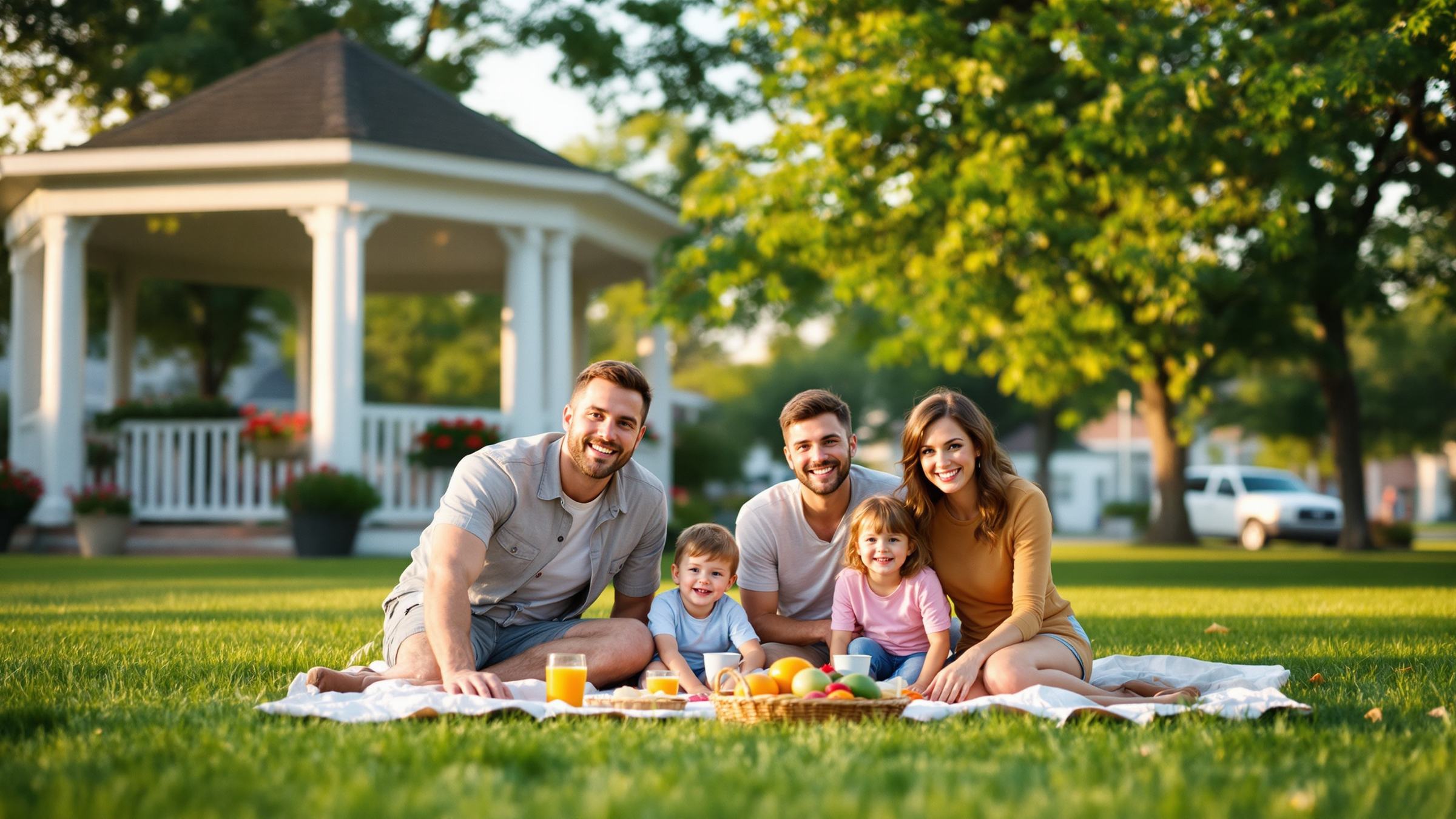
In a small American town, nobody asks where you're from. They ask whether you're coming to the game on Friday.
Small-Town Life in the USA: Church, the Fair and Football
Part of the guide Freedom in the USA: what it means in law and in everyday life
Three quarters of all American municipalities have fewer than 5,000 residents. Move to one and you're not just moving into a house, you're moving into a web of church, school, football field, fair and fire department. Join in and you belong. Stand on the sidelines and you stay a guest, treated kindly.
Europeans moving to a small American town usually expect wide open spaces, a porch and peace and quiet. They get all of that. What most don't expect is the opposite of quiet: a calendar full of commitments that live not in the office but at church, at school, on the football field and at the county fairgrounds. In America, the small town is no hideaway. It's a community that expects you to take part, and that welcomes you with open arms when you do.
This article is about everyday life, not property prices. Which towns offer newcomers money or land is covered in Small Town USA; which small regions are the strongest economically is covered in The ten best small towns in the USA. Here we tackle the question that comes after the move: what is life like there, and how do you become one of them?
1What counts as a small town in America
The European idea of a small town can mislead you, because in America the small town is the norm. According to the Census Bureau, as of July 1, 2019 there were around 19,500 legally independent municipalities, known as incorporated places. Around 76 percent of them had fewer than 5,000 residents, and of those, just under 42 percent had fewer than 500. So an American village often has its own mayor and city council, even when it's smaller than a single neighborhood of a European city.
For statistical purposes, an area only counts as urban if it has at least 2,000 housing units or 5,000 residents. Everything else is rural. In the 2020 Census, 20.0 percent of Americans lived in rural areas. The most rural state is Vermont at 64.9 percent. But the most rural residents live in Texas: 4,744,808 in the 2020 Census, more than in any other state.
Texas shows especially well how easily a municipality comes into being in America. To incorporate a general-law municipality there, you need just 600 residents for a Type A city and 201 for a Type B or C municipality. From 5,000 residents, a city may adopt its own constitution, the home-rule charter. Self-government in America starts very small. How counties, cities and school districts fit together is explained in County, city, school district.
| Metric | Value |
|---|---|
| Legally independent municipalities (incorporated places) | around 19,500 |
| of which with fewer than 5,000 residents | around 76 percent |
| of those, with fewer than 500 residents | just under 42 percent |
| Threshold for an urban area | at least 5,000 residents or 2,000 housing units |
| Share of rural population, USA 2020 | 20.0 percent |
| Largest rural population, 2020 | Texas, with 4,744,808 people |
| Most rural state, 2020 | Vermont, at 64.9 percent |
| Minimum size to incorporate a municipality in Texas | 600 residents (Type A), 201 residents (Type B and C) |
Source: U.S. Census Bureau, America: A Nation of Small Towns (estimate as of July 1, 2019); Census Bureau, Nation’s Urban and Rural Populations Shift Following 2020 Census; Census Bureau, Urban and Rural; Census Bureau, Individual State Descriptions: 2022 Census of Governments, Texas. Accessed October 24, 2026.
2Main Street, neighbors and first impressions
A small town has a center, and it's almost always called Main Street. That's where you'll find the diner, where the same men sit at the same counter every morning, the hardware store, the local bank branch, the post office and maybe a café opened by a couple from the big city. Out on the highway are the supermarket, the gas station and the feed store. Shop here and you keep running into the same people, and after a few weeks the cashier knows you're the European with the pickup.
This visibility is the first thing Europeans have to get used to. In a big city you're anonymous; in a small town you're not. That cuts both ways. Your car with the broken taillight gets noticed, and so does your help when the neighbors move. Rural Americans are often more reserved than the cliché of the ever-smiling American suggests. People say hello, wave from the pickup, help when there's trouble, and otherwise leave each other alone. Privacy is highly valued in the country, precisely because everyone knows everyone.
So, to start with: introduce yourself. Bring your neighbor something, ask about the best mechanic, the vet, the church, the high school game schedule. In America, asking isn't a sign of weakness, it's an invitation. And most answers come with a second invitation.
3The church: meeting place, charity and calendar
In many small towns, the church is the most important place outside your own four walls. That's about faith, but not only. The congregation organizes meals after funerals, rides for the elderly, summer programs for kids, collections after a storm and the potluck dinners where every family brings a dish. Newcomers get noticed there fastest, and even non-believers get invited.
Legally, church and state relate differently in America than in much of Europe. The First Amendment bars Congress from making any law establishing a state religion or prohibiting its free exercise. There is no church tax. Churches that meet the tax code's requirements are automatically treated as tax-exempt under IRS Publication 1828 and can receive tax-deductible donations. So a congregation lives on what its members give, which also explains why it does so much: it has to win people over to survive.
Visa, bank account, taxes and where to live: your move with Mount Bonnell Advisors.
4Friday night: high school football as a town festival
On fall Friday nights, Main Street is quiet in many small Texas towns, because everyone is at the stadium. There, high school football isn't school sport, it's a town festival. The band plays, the cheerleaders dance, parents sell hot dogs to raise money for the school, and in the stands sit grandparents who stood on the same turf fifty years ago. Have a child at the school and you'll soon be part of it, as a driver, a helper at the concession stand or a fan with a seat cushion.
School sports in Texas are run by the University Interscholastic League (UIL). Founded by the University of Texas at Austin to guide debate and athletics teachers at public schools, the UIL says it has grown since 1910 into the largest organization of its kind in the world, and it still operates as part of the university. Member schools are divided by enrollment into six conferences, from 6A to 1A, so schools play schools of the same size.
For the smallest schools, Texas has a specialty that amazes every European: six-man football, with six players a side instead of eleven and its own rulebook, which the UIL maintains alongside the rules for the full game. If a school doesn't have enough students for eleven players, it simply plays with six. That's the small town in its purest form: you don't wait until you're big enough, you adapt the rules and play.
5County fair, 4-H and FFA: where the country shows off its young people
Once a year, the county fairgrounds turn into a carnival that smells of livestock. The county fair is a stock show, a folk festival and a showcase all in one: cattle, pigs, goats and rabbits are judged, pies and jams win ribbons, and in the evening the rides start spinning. Center stage often belongs to kids and teenagers who have raised an animal themselves for months and now show it in the ring.
Behind many of these young people stand two organizations barely known in Europe. One is 4-H. According to the US Department of Agriculture, the program is led at the federal level by 4-H National Headquarters and delivered through the Cooperative Extension of the land-grant universities, the public universities that have carried their knowledge out to rural communities since the Smith-Lever Act of 1914. The other is FFA, formerly Future Farmers of America. It holds a federal charter from Congress, and the law states its purpose as being an integral part of agricultural education, including in public schools, and preparing students for careers in agriculture, food and natural resources.
For families moving from the city to the country, 4-H and FFA are often the fastest way into the community. The kids learn to take responsibility for an animal, the parents get to know the other parents, and by the first show day at the latest, half the town knows who you are. And yes, your child will end up knowing more about cattle breeds than you do.
6Volunteering and neighbors: the real infrastructure
What the state or an association organizes back home in Europe, people in a small American town often do themselves. According to data from the Census Bureau and AmeriCorps, between September 2022 and September 2023 around 75.7 million Americans aged 16 and over, or 28.3 percent, volunteered through an organization. Even more help out informally: 54.2 percent, around 137.5 million people, did favors for their neighbors during that period, from house-sitting and running errands to lending tools. About one in ten did so several times a week.
Out in the country you see this network everywhere. In many small towns the fire department is run by volunteers, as our article Volunteer fire departments and civic service shows. The library has a friends group, the cemetery has an association that looks after it, and the rodeo grounds have a club that keeps them going. And in Texas the school board, which decides on curriculum, budget and school buildings, is made up of elected citizens who serve without pay. How this local democracy works is explained in Elected, not appointed.
For you, that is an opportunity. Back home in Europe it can take years before a club lets you take on a role. In a small American town, someone will ask you at the second meeting whether you'd like to help, and they mean it. Say yes, and you're in.
7What newcomers from Europe underestimate
The distances. In a small town nothing works without a car, and the nearest specialist, the nearest hospital with a maternity ward or the nearest international airport can be an hour or more away. Before you buy, check how far it is to the things your family needs regularly. Schools are the second question: small towns often have just one school per level, and if you're looking for alternatives, Texas gives you a lot of freedom to teach at home, which we describe in our article on homeschooling in the USA.
The comparisons. Saying that things are done better back home may be true, but it won't open any doors. Small towns are proud of what they have built themselves, often over generations. If you listen and pitch in, people will ask you how it's done in Europe. If you lecture, you'll be treated politely and not invited back.
The history. In many small Texas towns you'll come across European roots: churches with German inscriptions and family names that have stayed the same for generations. In his report on the ranch, Sebastian Sauerborn describes one such town nearby, founded by German emigrants. It makes a lot easier, because you are far from the first European to arrive here.
In writing: which visa fits you and your family, prepared with the immigration attorney on the firm's team.
8How to settle into a small town
Rent first if you can, and get to know the town for a year before you buy. In your first weeks, go to a church service, a football game and a meeting of the Commissioners Court or the school board; under the Texas Open Meetings Act, every regular meeting of these bodies is open to the public. Sign your kids up for 4-H, FFA or a sports club. Ask the fire department whether they need volunteers. And invite the neighbors over for a barbecue, even if they don't invite you back right away.
The legal framework comes first. If you want to live in the USA for good, you need an immigration status that fits your plans, and a small town forgives a lot, but not a visa that runs out after three months. The visa roadmap shows which route is right for you and your family. How freedom, self-government and community fit together in America is covered in our guide Freedom in the USA, and why so many of our readers end up in Texas is on our page about Texas.
And then: patience. Belonging in a small town isn't about language or passport, it's about taking part. One Friday night you'll be sitting in the stands, someone will hand you a seat cushion, and you'll realize you're no longer the newcomer from Europe. You're the neighbor.
- Around 76 percent of the roughly 19,500 incorporated municipalities in the USA have fewer than 5,000 residents; Texas has the largest rural population of any state.
- In America, churches live on donations, not a church tax; for many families the church is meeting place, charity and calendar all in one.
- Friday night high school football is a community celebration in Texas; the UIL groups schools by size, and the smallest play six-man football.
- The county fair, 4-H and FFA bring together school, farming and youth; 28.3 percent of Americans volunteer, and 54.2 percent help their neighbors.
- Belonging comes from taking part: if you pitch in, you belong.
How we help you
- Visa RoadmapIn writing: which visa fits you and your family, prepared with the immigration attorney on the firm's team.
- Moving to the USAVisa, bank account, taxes and where to live: your move with Mount Bonnell Advisors.
- Visa and Green Card ConsultationWhich route to the USA fits you, settled in one conversation.
More on Freedom & Home
All articles → Small Town USA Read more →
 The Ten Best Small Cities in the USA Read more →
 Volunteer fire departments in the USA: where neighbors fight the fires Read more →
 Freedom in the USA: what it means in law and in everyday life Read more →
 Why I am no longer a conservative Read more →
 Homeschooling in the USA Read more →