
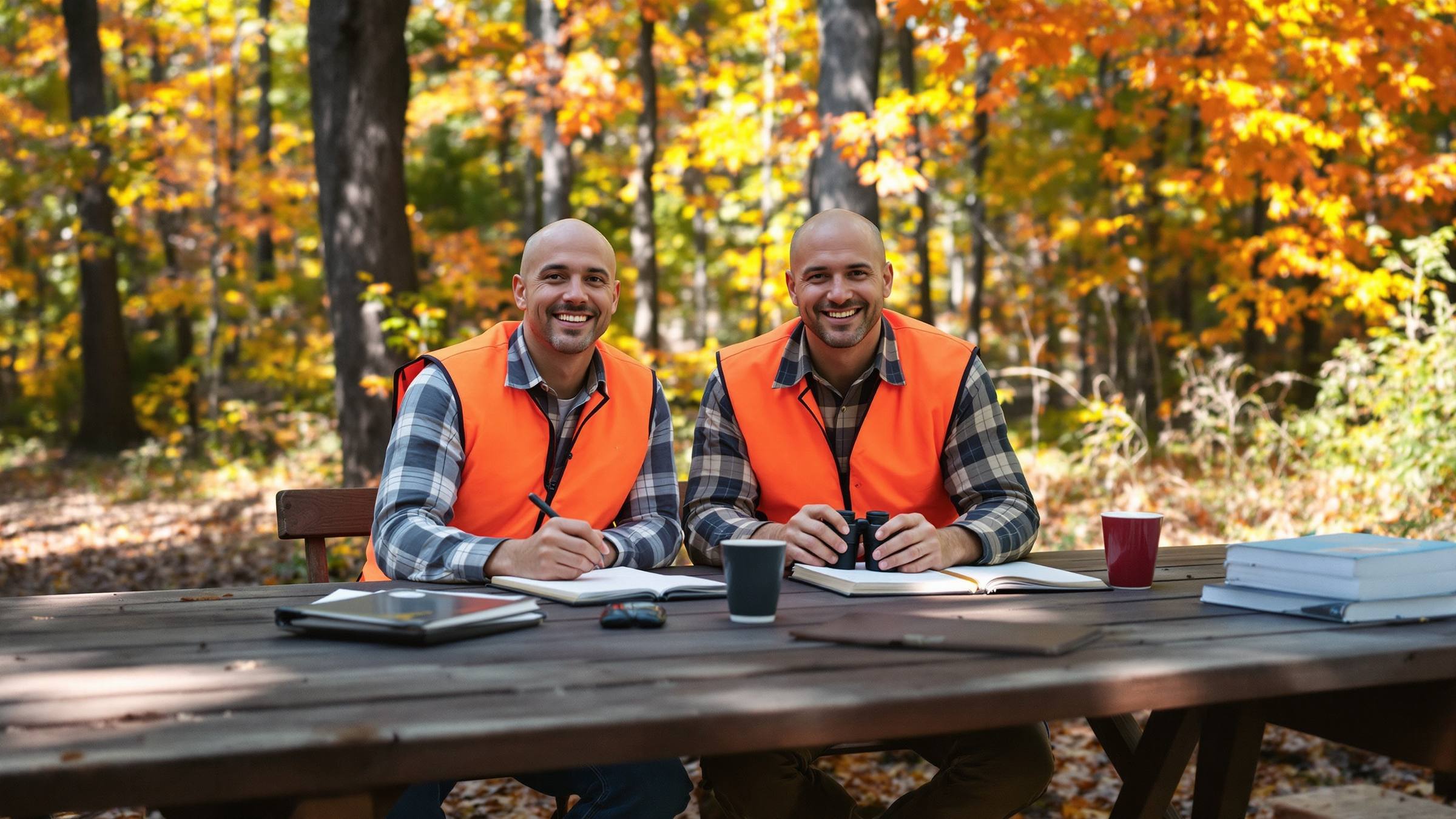
At home you passed a tough hunting exam. In Texas, the first thing they ask for is your date of birth.
Hunting License USA: Hunter Education, the License and Your Own Rifle
Part of the guide Freedom in the USA: what it means in law and in everyday life
The USA has no hunting certificate like the ones you know from Europe. Each state sells its own hunting licenses and requires a Hunter Education course, depending on your year of birth. For immigrants on a visa, the hunting license is also the key to owning firearms, and if you want to bring your own rifle, you need ATF approval first.
If you passed the hunting exam at home, you arrive in America with a certain pride. Then comes the surprise: nobody wants to see your certificate. The Texas clerk asks for your date of birth, your driver's license and your Social Security number, and then what you plan to hunt. The license comes out of the printer, Hunter Education takes a weekend, and in the woods what counts is what you do there.
That doesn't make it simple. Every state has its own rules for licenses and courses, and immigrants also face federal law: if you are in the country on a visa, you generally may not own a firearm, and the hunting license is one of the few exceptions. This guide sorts out both: what you need to hunt, what the license means for owning firearms, and how to bring your own rifle from Europe.
This page describes the law. It is not a recommendation to buy a firearm. If you hold a visa, check your eligibility before every purchase.
1Why the hunting certificate you know doesn't exist here
At home, a comprehensive exam comes before your first hunt. In the USA, hunting is a matter for the states, and they separate two things Europeans think of as one. The first is training, Hunter Education: a course on safe firearm handling, hunting law, ethics and wildlife, with a final exam. The second is the license: a right to hunt in a particular state, bought each year and supplemented by add-ons for certain species.
That has three consequences. First, there are as many rulebooks as there are states. Second, a resident license is much cheaper than a nonresident one, and each state decides for itself who counts as a resident. Third, the license opens a door that at first has little to do with hunting: under federal law, it is one of the exceptions to the firearms ban for immigrants on a visa.
2Hunter Education: the course before your first hunt
In Texas, every hunter born on or after September 2, 1971 needs a completed Hunter Education course, including hunters from out of state. The minimum age for certification is nine. The classroom course lasts six hours and costs $15 through the instructor. If you prefer to learn online, combine the free online course offered by the agency with a field day of at least four hours. From age 17 there is also a fully online course through approved private providers. The final exam requires a score of at least 75 percent.
If you are 17 or older and haven't taken the course, you can defer it once in your lifetime for one season. The deferral costs $10 and only applies if you hunt accompanied, within voice range of a hunter aged 17 or older who holds a license and has completed the course or was born before the cutoff date. Carry your proof while hunting, as a card, as a number on your license or in the agency's app. If you don't have it with you, you commit a Class C misdemeanor with a fine of $25 to $500. Texas recognizes certification from all other states and provinces. The agency says nothing about foreign courses, so expect to take the Texas course or another American one.
Florida requires the course for everyone aged 16 or older born on or after June 1, 1975, and before buying the license. Florida also offers a deferral: you tick it when buying and then hunt under the supervision of an adult aged 21 or older who holds a license and has completed the course. Georgia sets the cutoff at January 1, 1961 and lets you hunt without the course on an Apprentice License or a short-term license. Georgia recognizes courses approved by a state wildlife agency or a Canadian province.
| Texas | Florida | Georgia | |
|---|---|---|---|
| Course required for | all hunters, including nonresidents, born on or after September 2, 1971 | everyone aged 16 or older born on or after June 1, 1975, before buying the license | residents and nonresidents born on or after January 1, 1961, before buying a season license |
| Without the course | one-time deferral from age 17 for one season, $10, accompanied only | deferral when buying the license, only under supervision of an adult aged 21 or older | Apprentice License and short-term licenses without the course |
| Course formats | classroom course, 6 hours; online plus field day; online only from age 17 | online plus field day; classroom course | classroom course; online for Georgia residents |
| Other proof accepted | courses from all other states and provinces | nothing stated for foreign courses | courses from any state wildlife agency and Canadian provinces |
Source: Texas Parks and Wildlife Department, Hunter Education and Hunter Education FAQ; Florida Fish and Wildlife Conservation Commission, Hunter Safety and Hunter Safety Certification Deferral; Georgia Department of Natural Resources, Hunter Education. Accessed October 24, 2026.
3The license: resident or nonresident
In Texas, you count as a resident if you have lived in Texas continuously for more than six months before buying. At purchase you show a Texas driver's license or ID card not marked as temporary or limited term. As proof of the six months, the agency may ask for a driver's license issued at least six months earlier plus two further documents, such as utility bills or pay stubs from the last six months, your latest tax return or a Texas License to Carry. If you don't meet these requirements, you buy the nonresident license.
Texas licenses are valid from purchase until August 31; sales for the new season start on August 15. The nonresident license comes as an annual license for all hunting, including white-tailed and mule deer, and as a five-day license for small game and exotics. You need add-ons, called endorsements, for things like migratory birds, upland game birds or archery; for waterfowl, hunters aged 16 or older also need the federal Duck Stamp. One thing newcomers should know: Texas asks for your Social Security number at purchase. If you don't have one and don't need one, you sign an affidavit the agency provides for this.
In Florida, you count as a resident if you have declared Florida your only state of residence and can prove it with a Florida driver's license or ID card whose residency the licensing agency has verified. Hunting wild hogs in Florida doesn't require a fur-bearer license because they don't count as game; you need the landowner's permission. So when you move, the license question hangs on your driver's license. How to transfer it is explained in the guide Converting your driver's license in the USA.
| License | Texas | Florida |
|---|---|---|
| Resident, one year | $25 (valid until August 31) | $17 |
| Nonresident, one year | $315 (Non-resident General Hunting License, valid until August 31) | $151.50 |
| Nonresident, short term | $48 for five days, small game and exotics, not white-tailed deer | not listed in this selection |
| Youth under 17 | $7, nonresidents included | not listed in this selection |
| Add-ons | Endorsements, e.g. for migratory birds and archery | Permits, e.g. for turkey and migratory birds |
Source: Texas Parks and Wildlife Department, Hunting Licenses, Purchase Requirements and Hunting Endorsements; Florida Fish and Wildlife Conservation Commission, Hunting Licenses. State fees; online purchases in Texas add a $5 processing fee. Accessed October 24, 2026.
4The hunting license as the key to gun ownership
Under 18 U.S.C. § 922(g)(5)(B), noncitizens admitted on a nonimmigrant visa may not possess, receive or transport firearms or ammunition. That covers E-2, L-1, H-1B and every other nonimmigrant visa. The exception in § 922(y)(2)(A) applies to visa holders admitted for hunting or sporting purposes or who hold a valid hunting license issued in the USA. The law doesn't require a license from any particular state. If you have lived in the country continuously for at least 180 days, you can also apply to the Attorney General for a waiver under § 922(y)(3).
When you buy in a store, you fill out ATF Form 4473. Among other things, it asks for your country of citizenship, your alien or admission number and your state of residence. If you buy on a visa and rely on an exception, you show the dealer your proof, and the dealer notes it on the form and attaches a copy, as 27 CFR 478,124 requires. Under § 922(b)(3), a dealer may sell handguns only to residents of the dealer's own state. Rifles and shotguns may also go to residents of other states, provided both parties meet in person and the sale is legal under the laws of both states.
Two groups fall outside the ban for visa holders. A green card holder is not a nonimmigrant. And anyone entering visa-free on ESTA is also not covered, under an ATF ruling from 2012. A tourist, however, has no state of residence, as an example in the ATF regulations states explicitly, no matter how long the vacation lasts. For everyone: a firearms violation can lead to deportation under 8 U.S.C. § 1227(a)(2)(C). So if you hold a visa, check that you are eligible before every purchase. The rules by status are in the guide Gun ownership as an immigrant, buying with a green card under Buying a gun with a green card, and the consequences of a violation under Gun law and immigration status.
In writing: which visa fits you and your family, prepared with the immigration attorney on the firm's team.
5Bringing your own rifle: Form 6NIA
If you are a nonimmigrant temporarily bringing firearms or ammunition into the USA for hunting or sport, you need an approved ATF Form 6NIA (official number 5330.3D) beforehand, as 27 CFR 478,120 requires. If you enter on a visa, attach proof of an exception to the application, usually your US-issued hunting license, and show the same proof to CBP when you enter. Only then may the firearm come into the country. In practice: buy the license, then apply, then fly. Processing is up to the ATF, so allow plenty of lead time. US citizens and green card holders are not nonimmigrants and are not subject to this rule.
Leaving home takes planning too. Within the EU, Regulation 258/2012 applies. Under its Article 9, hunters and sport shooters taking their firearms temporarily out of the EU in accompanied baggage need no export authorization, as long as they can show the reason for the trip, for example with an invitation to a hunt. For hunters, ammunition is limited to 800 rounds. If you leave the EU through a member state other than the one you live in, you present the European Firearms Pass. Switzerland is not in the EU and has its own export rules; check with the authorities there before you book.
On the plane, the rules of the TSA, the US aviation security agency, apply. Firearms travel only unloaded, in a locked hard-sided case and only in checked baggage. You declare them at the check-in counter, every time. Ammunition goes in packaging made of cardboard, wood, plastic or metal designed for it, and may travel in the same locked case. How much ammunition is allowed is up to the airline. Ask them before you book, including about fees.
6Hunting in Texas
Texas is a special state for hunters. The state agency offers more than a million acres of public hunting land, but many hunters hunt on private land, as a landowner's guest or through a lease. Anyone who leases out their hunting rights for money needs a license of their own for it, tiered by acreage: up to 499 acres, up to 999 acres and 1,000 acres or more. On private land, with the owner's permission, you can even hunt feral hogs without a hunting license; the same goes for coyotes attacking livestock. For everything else, the license requirement applies to everyone, resident or nonresident, of any age. What makes hunting in Texas special, from leases and ranches to feral hogs, is covered in the guide Hunting in Texas.
If you buy your own ranch, you hunt on your own land, but you still need the license and, depending on your birth year, the course. The Texas license is valid only in Texas. If you also want to hunt in Oklahoma, Colorado or Montana, you buy each state's nonresident license. You usually do not have to repeat the course: according to the Texas agency, every state and province that requires hunter education accepts the Texas certificate.
7What to sort out before your first season
It starts with your status. With a green card, the general rules apply to you. On a visa, the hunting license decides whether you may possess a firearm. The law speaks of possessing a valid license, so expect that it must be valid for as long as you have the firearm. The Texas license expires on August 31, and an expired license no longer counts as an exception. If you own firearms year-round, buy your new license in good time, from August 15.
Next come the course and the license. If you were born on or after September 2, 1971, you take the course in Texas, online or with a field day. If you have lived in Texas for less than six months or do not yet have a Texas driver's license, you buy the nonresident license. And if you want to bring your own rifle, you file Form 6NIA with your license, sort out the export at home and talk to the airline.
One last piece of advice you won't find in any law: for your first season, find someone who knows the area. Hunter education instructors in Texas are volunteers, and taking their course is often how you meet the first hunters in your area. How volunteering works in small-town America is covered in the guide Volunteer Fire Departments, and the big picture in the overview Freedom in the USA.
Find the right path to the USA for you in one conversation.
- The US has no European-style hunting license: each state sells its own licenses for residents and nonresidents and, depending on birth year, requires a hunter education course.
- Texas requires the course for everyone born on or after September 2, 1971, and accepts courses from all other states and provinces; the agency says nothing about foreign certificates.
- Under 18 U.S.C. § 922(y)(2), a hunting license issued in the US is one of the exceptions that allow a visa holder to possess a firearm; check your eligibility before every purchase.
- Nonimmigrants who want to bring in their own rifle need an approved ATF Form 6NIA in advance; visa holders also submit their hunting license.
- Hunters leaving the EU with firearms in accompanied baggage need no export authorization if they can show the purpose of the trip; on the plane, TSA rules apply.
How we help you
- Visa RoadmapIn writing: which visa fits you and your family, prepared with the immigration attorney on the firm's team.
- Visa and Green Card ConsultationWhich route to the USA fits you, settled in one conversation.
- Moving to the USAVisa, bank account, taxes and where to live: your move with Mount Bonnell Advisors.
More on Freedom & Home
All articles → Hunting in Texas: licenses, feral hogs and hunting leases on private land Read more →
 US gun laws: how to buy a gun legally as a foreigner Read more →
 Freedom in the USA: what it means in law and in everyday life Read more →
 Why I am no longer a conservative Read more →
 Small Town USA Read more →
 Homeschooling in the USA Read more →