
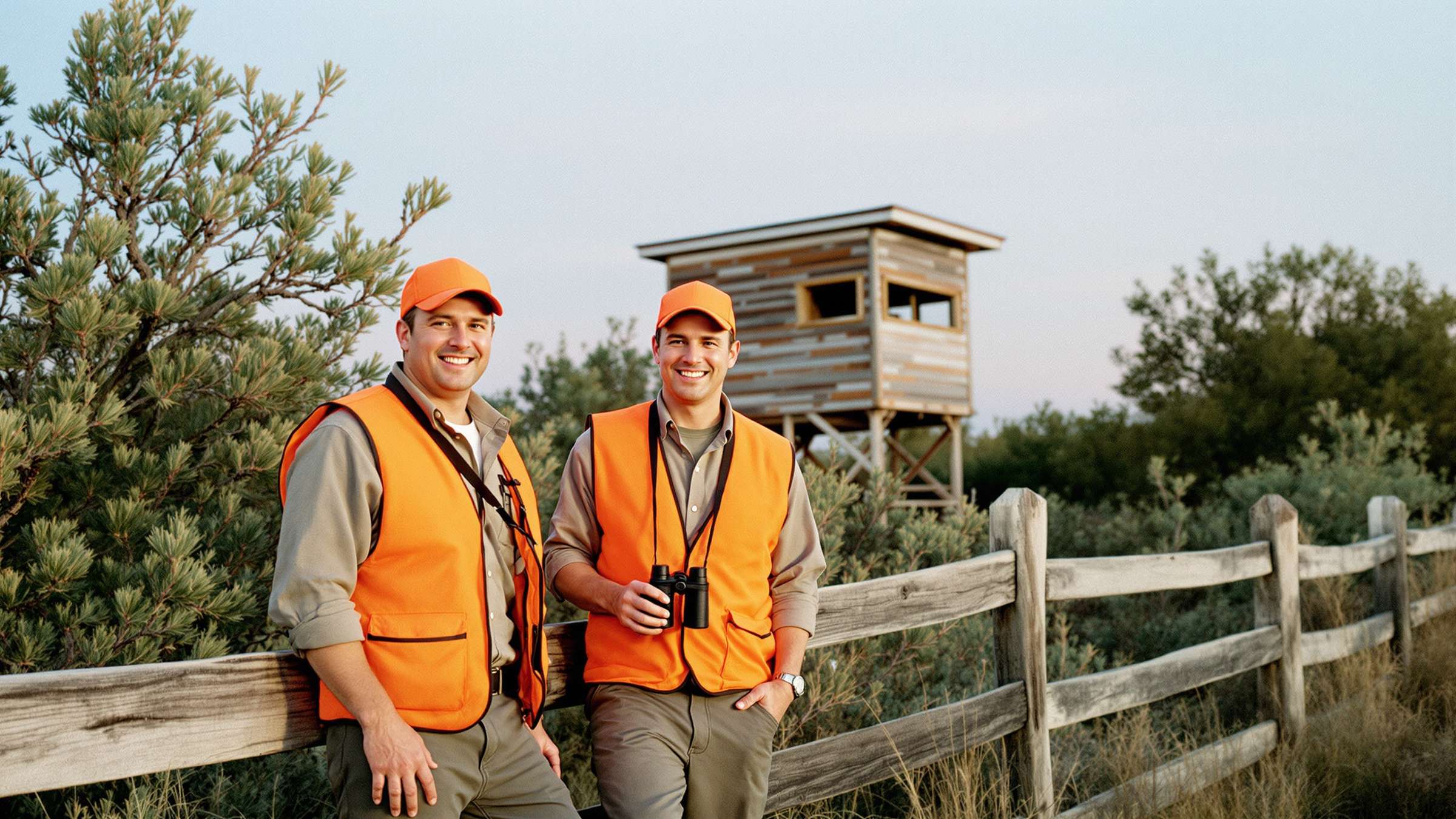
94 percent of Texas belongs to private owners. So if you want to hunt here, you need a neighbor first and a license second.
Hunting in Texas: License, Feral Hogs and Hunting Leases on Private Land
Part of the guide Freedom in the USA: what it means in law and in everyday life
Wide open spaces, plenty of game and a hunting year that starts in September: for hunters from Europe, Texas is a dream destination. The rules are clear, but different from home. There is no state-run hunting ground, just your neighbor's fence, and you buy your license at the store around the corner.
In Texas, almost everything about hunting works differently from back home, and it starts with the ground beneath your feet. The state owns very little land. According to the Texas Parks and Wildlife Department (TPWD), 94 percent of Texas is privately owned, which puts the state's wildlife in the care of private landowners. The game belongs to everyone; the land it stands on almost always belongs to someone.
For you, that means the license is quick to buy, and the land is the real question. This article covers both, using the rules for the 2026/27 hunting year: who counts as a resident, what the license costs, how Hunter Education works, why the feral hog has a special status in Texas, how hunting leases work and what federal law says about hunters on a visa. For hunting in other states and bringing your own firearms, see our article Hunting in the USA.
1Why hunting in Texas starts with the landowner
Texas wildlife law opens with a rule you should never forget. Under § 61,022 of the Parks and Wildlife Code, no one may hunt, trap or possess wildlife on someone else's land without the consent of the owner or the owner's agent. A first offense is a Class A misdemeanor. Taking a white-tailed deer, mule deer, pronghorn or desert bighorn sheep without consent is even a state jail felony, and hunting and fishing licenses can be revoked. A second offense moves up one level.
There is no hunting district in the European sense, following municipal boundaries and leased out by an association. There is the ranch, the fence and the person who owns both. That is why every hunt in Texas begins with a question to a neighbor, a friend, a colleague or a landowner who leases. How much these relationships matter in rural areas is something we describe in our article on life in a small American town.
There is some public land, though. TPWD offers public hunting on more than a million acres (a good 400,000 hectares): on state-owned land and on land the department leases from other agencies, timber companies and private owners. Access is through the Annual Public Hunting Permit for $48, which lets you hunt white-tailed deer, feral hogs, dove, quail, turkey, waterfowl and rabbit on more than 180 areas. On top of that there are drawn, supervised hunts you apply for through the Public Hunt Drawing System, plus programs where experienced hunters mentor newcomers. It's the ideal start: you get to know the land before committing to a lease.
2Resident or visitor: which license you need
Every hunter in Texas needs a license, resident or not, whatever their age. That applies to every animal, bird, frog and turtle. TPWD lists only a few exceptions: coyotes attacking livestock, feral hogs on private land with the owner's permission and furbearers in certain cases. All licenses are valid from purchase through August 31; sales for the new hunting year start on August 15.
2.1Who counts as a resident
Under hunting law, a resident is someone who has lived in Texas continuously for more than six months immediately before buying the license. Active-duty members of the US armed forces and their families also qualify. Anyone claiming residency in another state for any purpose is not a resident. For newcomers, that means you hunt as a non-resident for your first six months after the move, and as a resident at the resident price after that. You'll notice the difference: the Resident Hunting License costs $25, the non-resident license $315.
2.2Non-resident licenses
Visitors have two options. The Non-resident General Hunting License covers every game animal, and it is the only license that lets non-residents hunt white-tailed or mule deer, pronghorn or desert bighorn sheep. The Special 5-Day License is valid for five consecutive days printed on the license and covers exotics, upland game birds except turkey, small game, furbearers, squirrels and javelinas, but not deer. Depending on the game, you'll need endorsements: for the archery-only season, for turkey, pheasant and quail, and for migratory birds. Hunters under 17 pay $7 for the Youth Hunting License, even if they don't live in Texas.
| License or endorsement | Who it's for | Fee | What it allows |
|---|---|---|---|
| Resident Hunting License | Texas residents | $25 | any game animal, endorsements as needed |
| Senior Resident Hunting License | residents aged 65 and over | $7 | same as the Resident License |
| Youth Hunting License | hunters under 17, including non-residents | $7 | exempt from most endorsements |
| Non-resident General Hunting License | non-residents | $315 | any game animal; the only license for white-tailed and mule deer |
| Non-resident Special 5-Day | non-residents | $48 | five consecutive days: exotics, small game, upland birds except turkey, no deer |
| Archery Endorsement | everyone | $7 | hunting during the archery-only season |
| Upland Game Bird Endorsement | everyone | $7 | turkey, pheasant, quail |
| Migratory Game Bird Endorsement | everyone | $7 | migratory birds such as dove and duck; for waterfowl also the Federal Duck Stamp ($25) |
| Hunter Education Deferral | age 17 and over, once only | $10 | one hunting year without the course, accompanied only |
| Annual Public Hunting Permit | everyone | $48 | state public hunting lands |
Source: Texas Parks and Wildlife Department, Outdoor Annual 2026/27: Hunting Licenses, Hunting Endorsements, Hunter Education; TPWD, Annual Public Hunting Permit. Accessed October 24, 2026.
In writing: which visa fits you and your family, prepared with the immigration attorney on the firm's team.
3Hunter Education: the course visitors take too
Texas has no hunting license exam of the European kind. Instead there is Hunter Education, a course on safety, firearm handling, wildlife and hunting ethics. Every hunter born on or after September 2, 1971 must have completed it, and TPWD states explicitly: that includes hunters from other states. You carry proof with you while hunting, printed or in the department's official app. You don't need it to buy the license, but you do to hunt.
The minimum age for the course is nine. The in-person course costs $15; if you're 17 or older, you can also take it online with an approved provider, where fees vary. Children under nine may only hunt accompanied; youths aged nine to sixteen hunt with the course or accompanied. A companion must be at least 17, licensed to hunt in Texas, have passed the course or been born before the cutoff date, and stay within normal voice control.
If you can't complete the course before your first season, you can defer it once. The Hunter Education Deferral costs $10, is valid until the end of the hunting year and requires you to be at least 17 and hunt accompanied. You only get one deferral. The only people exempt from the course are active and honorably discharged members of the US armed forces, members of the Texas National Guard and Texas State Guard, and peace officers. A hunting license from Europe is not on that list. Take it less as a snub than as an opportunity: the course is the fastest way to meet Texas hunters.
4The feral hog: Texas's favorite enemy
No animal shapes hunting in Texas like the feral hog, and none is less welcome. Pigs aren't native to North America. Spanish explorers brought them over, and escaped domestic pigs turned into wild populations. Citing studies, TPWD puts the US population at 6.9 million animals in 2016, an estimated 2.6 million of them in Texas. According to a map the department shows, El Paso was the only county in Texas without feral hogs in 2019.
The hogs root up pastures, foul water and strip fields bare. Recent studies cited by TPWD estimate the annual damage to Texas agriculture at around $118.8 million. That explains why the law is so generous here. On private land, you may hunt feral hogs with the owner's permission without a hunting license. Hunter Education still applies, though. Exotics, feral hogs and other non-protected species have no closed season, no bag limit and no required hunting method on private land. Trapping on private land is allowed, and so is baiting.
There are two limits you should know. Transporting and releasing live feral hogs is prohibited unless it complies with the disease rules of the Texas Animal Health Commission. And hunting from a helicopter or plane, which ranchers use against large sounders, requires a separate permit from the department. TPWD points out plainly that recreational hunting alone won't reduce the population: Texas estimates suggest around 29 percent of the animals are taken each year, while 66 to 70 percent would be needed just to hold numbers steady. So every hunter is welcome here, and the meat is excellent.
5White-tailed deer, turkey and the ranch exotics
The white-tailed deer is the classic Texas game animal. In the 2026/27 hunting year, the archery-only season runs from October 3 to November 6, 2026. The general season opens on November 7, 2026 and closes on January 3, 2027 in the North Zone and January 17, 2027 in the South Zone. On top of that come youth weekends, a muzzleloader season and late special seasons. 252 of the 254 counties have a deer season, and the exact rules, such as bag limits and antler restrictions, are listed by county in the department's Outdoor Annual. Check your county before you head out.
When it comes to firearms and methods, Texas is generous, with a few clear limits. Rimfire ammunition is prohibited for deer, mule deer, bighorn sheep and pronghorn, and so are fully automatic firearms. You may use a suppressor for any game, as long as you comply with federal, state and local law. On private land you may hunt from a vehicle and bait game. Shooting from or across a public road is prohibited, as is using artificial light to illuminate game animals or game birds.
Then there are the exotics. An exotic is any animal not native to Texas, such as aoudad, axis deer, elk, sika deer, fallow deer, red deer, blackbuck and nilgai. Many ranches keep these animals, and on private land they have no closed season and no bag limit. You still need a hunting license, and hunting an exotic without the landowner's permission is a Class A misdemeanor. As a European, you may find this especially appealing: the red deer you know from home is on the Texas exotics list.
6Hunting leases and ranches: how to get access to land
Most Texans hunt on their own land, on land belonging to family and friends, or on leased land. A lease is an agreement between you and the owner. Wildlife law does require a license for it, but not from you: anyone who leases hunting rights on land they own or control for money or other consideration needs a Hunting Lease License, and it must be posted on the property. The fee depends on the acreage.
No law spells out in detail what belongs in a hunting lease, which is exactly why care pays off. Put it in writing: which land and which game the lease covers, for what period, how many hunters and guests may come, whether blinds and feeders are allowed, who is responsible for fences and gates, and what happens with feral hogs you want not only to hunt but also to trap. Ask about the county's harvest rules and whether the owner has rules of his own, such as a minimum age for bucks. Skip this, and you'll be arguing by year two.
Buy your own ranch, and you soon see hunting from the other side. Now you're the one others ask for permission, and the one who needs a Hunting Lease License if you lease. What life on a ranch east of Austin feels like, with fences, a pond and wild hogs in the woods, Sebastian Sauerborn describes in his account of his years on a ranch in Texas.
| Acreage | Fee |
|---|---|
| 1 to 499 acres (up to about 200 hectares) | $79 |
| 500 to 999 acres | $147 |
| 1,000 acres or more | $252 |
Source: Texas Parks and Wildlife Department, Outdoor Annual 2026/27, Hunting Licenses: Hunting Lease Licenses. Conversion: 1 acre is about 0.4 hectares. Accessed October 24, 2026.
7Firearms and immigration status: the federal rule
Texas wildlife law asks where you live; federal law asks about your immigration status. Under 18 U.S.C. § 922(g)(5)(B), foreign nationals admitted to the US on a nonimmigrant visa may not possess firearms or ammunition. That covers, for example, holders of an E-2, L-1 or H-1B visa. The law does have exceptions, though, and the most important is in § 922(y)(2)(A): the ban does not apply to people admitted for lawful hunting or sporting purposes, or who hold a hunting license lawfully issued in the US.
So a valid Texas hunting license is more than permission to hunt. For visa holders, it is the key to being allowed to own a firearm at all. Anyone who wants a firearm without such an exception can apply to the Attorney General for a waiver. Under § 922(y)(3), you must have lived in the US continuously for at least 180 days and include a written statement from your embassy or consulate.
If you want to bring your own firearms from Europe, 27 C.F.R. § 478,120 requires an approved ATF Form 6NIA before import. Visa holders attach proof of the exception to the application, such as the hunting license, and also show it to Customs and Border Protection on arrival. Whether and how the federal rule covers ESTA travelers, who have no visa at all, depends on the definition of a visa in 27 C.F.R. § 478.11 and is a topic of its own. We've written it up in Gun ownership as an immigrant, by status, buying with a green card in Buying a gun with a green card, and the consequences of a violation for your visa in Gun law and immigration status. A mistake here can cost you your right to stay, so if hunting matters to you, it belongs in every plan for your move.
Find the right path to the USA for you in one conversation.
8Your first hunting year in Texas, step by step
In the end, the path into Texas hunting country is manageable if you stick to the right order. First, Hunter Education, because it's mandatory anyway and because in the course you meet the people who later know about land, leases and blinds. Then look at your status: if you've lived in Texas for more than six months, you buy the resident license; otherwise the nonresident one. If you're in the country on a visa, the hunting license is also the exception you need to own a firearm.
Next, the land. For the first year, the Annual Public Hunting Permit is often enough, and for hog hunting, permission from a rancher friend who's glad for every animal taken will do. For deer and exotics on private land you need a lease or an invitation, and for deer as a nonresident, the General License. Finally, the county: bag limits, antler restrictions and special seasons are set where you hunt, not in one law for the whole state.
Those who want to hunt usually want to stay, too. Which visa routes are open to you and your family, and which status fits your plans for life on the land, is what the visa roadmap sorts out. How freedom, property and community fit together in America is covered in our guide Freedom in the USA, and why so many of our readers end up in Texas of all places, on our page about Texas.
- 94 percent of Texas is privately owned. Hunting on someone else's land without the owner's consent is a crime; for deer it is a state jail felony.
- If you haven't lived in Texas for more than six months, you buy the Non-resident General Hunting License for $315; it is valid through August 31.
- Anyone born on or after September 2, 1971 needs Hunter Education, including guests from abroad; you can defer the course once for $10.
- On private land, with the owner's permission, you may hunt feral hogs without a hunting license, with no closed season and no bag limit; the course is still required.
- If you're in the US on a visa, federal law lets you own firearms only under an exception; the most important is a valid US hunting license.
How we help you
- Visa RoadmapIn writing: which visa fits you and your family, prepared with the immigration attorney on the firm's team.
- Moving to the USAVisa, bank account, taxes and where to live: your move with Mount Bonnell Advisors.
- Visa and Green Card ConsultationWhich route to the USA fits you, settled in one conversation.
More on Freedom & Home
All articles → Hunting license in the USA: hunter education, licenses and your own rifle Read more →
 Owning a gun in the USA as a foreigner: what federal law says Read more →
 Freedom in the USA: what it means in law and in everyday life Read more →
 Why I am no longer a conservative Read more →
 Small Town USA Read more →
 Homeschooling in the USA Read more →