
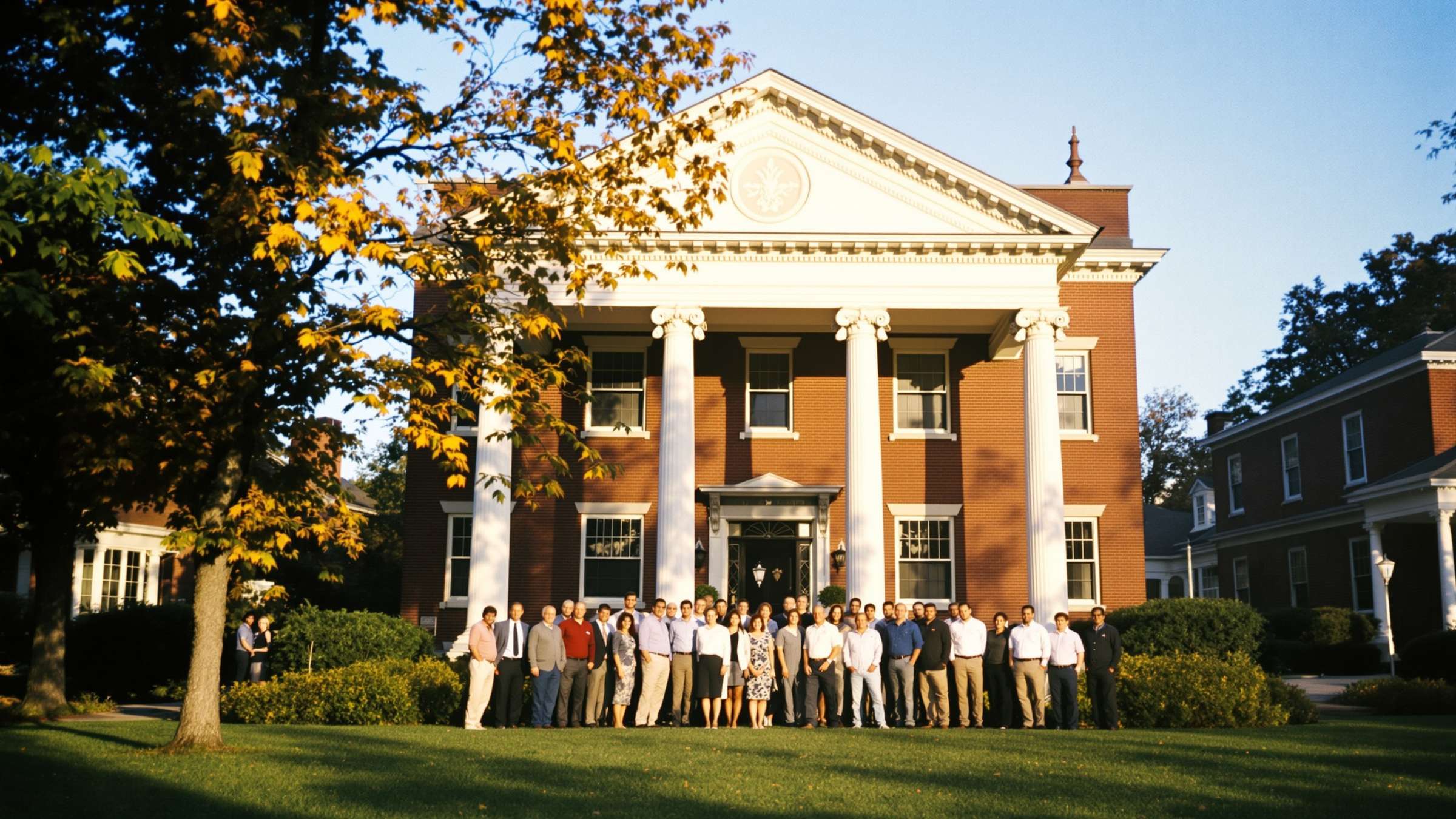
In most of Europe, you get a public office through appointment. In Texas, the sheriff goes on the ballot, every four years.
Elected, not appointed: Sheriff, Judges and School Board in Texas
Part of the guide Freedom in the USA: what it means in law and in everyday life
Americans don't just elect legislatures and mayors. They also elect the sheriff, the judges, the county attorney and the school board. For newcomers from Europe, this is one of the biggest surprises of local democracy. Once you know these offices, you understand how close government in America is to its citizens.
Live in a Texas county and your November ballot lists offices nobody back home in Europe votes for: the sheriff, the precinct constable, the justice of the peace, the county attorney, the district judges and the judges of the state's highest courts. Then there are the school board elections, for which the election code also sets a date in May. This is no curiosity. It's a core idea of American self-government: whoever holds power over their neighbors should answer to them.
This article explains the key elected offices using Texas as the example, based on the state's constitution and statutes, and compares them with how Europe chooses its officials. How counties, cities and school districts split their duties is covered in the article County, city, school district.
1The sheriff: the county's elected lawman
The Texas Constitution deals with the sheriff in a single sentence. Under Art. V § 23, the voters of each county elect a sheriff who serves for four years. The legislature sets the sheriff's duties, qualifications and fees, and if the office falls vacant, the Commissioners Court fills it until the next general election. Texas has 254 counties, and every one has its sheriff.
What the sheriff does comes from many statutes. One duty is spelled out especially clearly: under § 351,041 of the Local Government Code, the sheriff of each county is the keeper of the county jail. The sheriff holds every prisoner committed there by a competent authority and may appoint a jailer, but keeps supervision and control.
Not just anyone can run. Under § 85.0011 of the Local Government Code, a sheriff needs a high school diploma or equivalent and an active permanent peace officer license. Without that license, you can only run if you meet the requirements for it and have either worked at least five years as a federal investigator or, as a veteran, served at least ten years of active duty or National Guard service; the license must then be obtained within the deadline. So the election doesn't replace qualifications, it comes on top of them.
Figures from the Bureau of Justice Statistics show how widespread the office is. In 2018, the USA had 3,051 sheriff’s offices with 192,380 full-time sworn officers, alongside 11,824 local police departments. No state had as many sheriff’s offices as Texas, with 252. According to the statistics, no sheriff’s office in Alaska, Connecticut, Delaware, Hawaii or the District of Columbia had general police jurisdiction.
| Metric | Value |
|---|---|
| Sheriff’s offices in the USA, 2018 | 3.051 |
| Full-time sworn officers in sheriff’s offices | 192.380 |
| State with the most sheriff’s offices | Texas, 252 |
| followed by | Georgia 156, Virginia 122, Kentucky 115, Missouri 113 |
| No sheriff with general police jurisdiction | Alaska, Connecticut, Delaware, Hawaii, District of Columbia |
| Sheriff's term in Texas | four years |
Source: Bureau of Justice Statistics, Census of State and Local Law Enforcement Agencies, 2018, Statistical Tables (October 2022), counting agencies with at least one full-time-equivalent sworn officer; Texas Constitution, Art. V § 23. Accessed 24 October 2026.
2Constable, justice of the peace and Commissioners Court
Below the sheriff, democracy goes one level deeper. Art. V § 18 of the Texas Constitution divides each county into precincts, their number depending on population. In each precinct, citizens elect a justice of the peace and a constable, both for four years. The constable is an elected law enforcement officer for the precinct; according to the Bureau of Justice Statistics, the USA had 647 constable and marshal agencies in 2018.
The county is governed by the Commissioners Court. It consists of four county commissioners, elected from four precincts for four years, with the county judge presiding, and under the constitution it exercises the powers over county business that the constitution and statutes give it. The county judge is elected by all the county's voters for four years. The constitution requires the judge to be well informed in the law of the state and also makes the judge a conservator of the peace. The county attorney, who represents the state in the county's courts, is also elected for four years under Art. V § 21.
These are no honorary posts. They decide on the county's roads, budget, jail and courts, and their meetings are public: under § 551,002 of the Government Code, every regular, special or called meeting of a governmental body must be open, and the law expressly includes the Commissioners Court. Want to know how your county works? Just go and sit in.
Visa, bank account, taxes and where to live: your move with Mount Bonnell Advisors.
3Judges on the ballot
What Europeans find most unusual is electing judges. In Texas, citizens elect them at every level. The Supreme Court of Texas has a chief justice and eight justices. They are elected statewide for six years, three of them every two years. The Court of Criminal Appeals has a presiding judge and eight judges, also elected for six years. Courts of appeals justices are elected in their districts for six years, district judges in their judicial districts for four years.
Here, too, the election doesn't replace qualifications. Under Art. V § 7, a district judge must be a US citizen and a resident of Texas, be licensed to practice law in Texas, have practiced law or served as a judge in Texas for eight years without the license being revoked or suspended, and have lived in the district for the two years before the election. If a seat on one of the higher courts falls vacant, the governor fills it under Art. V § 28 until the next general election, when voters decide on the rest of the term. So a judge can take office by appointment and must then face the voters.
Switzerland sits in between, which makes it so interesting for comparison. Federal Supreme Court judges are elected by the Federal Assembly, the parliament, under Art. 168 of the Federal Constitution. In some cantons, the people elect the judges of the lower courts. In the canton of Zurich, for example, Art. 75 of the cantonal constitution provides that the cantonal parliament elects the members of the courts with canton-wide jurisdiction, while the people elect the members of the other courts. A Zurich native moving to Texas already knows the principle from home.
| Office | Elected by | Term | Legal basis |
|---|---|---|---|
| Supreme Court of Texas, nine justices | Statewide voters, three seats every two years | Six years | Art. V § 2 |
| Court of Criminal Appeals, nine judges | Statewide voters | Six years | Art. V § 4 |
| Courts of Appeals | Voters of the district | Six years | Art. V § 6 |
| District Judge | Voters of the judicial district | four years | Art. V § 7 |
| County Judge | Voters of the county | four years | Art. V § 15 |
| County Commissioner, four per county | Voters of the district | four years | Art. V § 18 |
| Justice of the Peace and Constable | Voters of the precinct | four years | Art. V § 18 |
| County Attorney | Voters of the county | four years | Art. V § 21 |
| Sheriff | Voters of the county | four years | Art. V § 23 |
| School board (Board of Trustees) | Voters of the school district | three or four years, staggered | Education Code § 11,059 |
Source: Texas Constitution, Art. V; Texas Education Code §§ 11,051 to 11,061 (Texas Legislative Council). Accessed 24 October 2026.
4The school board: citizens who run the schools
Schools in Texas aren't run by a ministry but by school districts that are legal entities in their own right. Under § 11,051 of the Texas Education Code, each independent school district is governed by a board of trustees that oversees the district's management and ensures the superintendent implements its plans and programs. Individual members can't act for the board on their own; decisions are made by majority in a public meeting.
Trustees serve three or four years, with staggered terms so the whole board never changes at once. The board can decide to elect trustees from single-member districts rather than district-wide. Only registered voters can run, and trustees serve without pay. Elections take place on one of Texas's uniform election dates, which for political subdivisions other than counties also include a date in May.
According to the Census Bureau, there were 12,535 independent school districts in the US in 2025. In Germany, Article 7(1) of the Basic Law places the entire school system under state supervision. In Texas the path is shorter: if you disagree with the curriculum, the budget or the new school building, you go to the next public school board meeting and tell the people you elected. Read more about life around school in our article on life in a small American town.
5When elections happen and how many governments there are
The Texas election code bundles the dates. Under § 41,002 of the Election Code, the general election for state and county offices is held on the first Tuesday after the first Monday in November of every even-numbered year. For other elections, § 41,001 sets uniform dates: the first Saturday in May and the first Tuesday after the first Monday in November. So voting in Texas doesn't mean choosing a parliament every few years, but regularly deciding on a whole list of offices.
The Census Bureau's figures show just how dense this network is. In 2025 the US had 91,438 local governments: 3,031 counties, 19,489 cities and towns, 16,184 townships, 12,535 independent school districts and 40,199 special districts that handle things like water supply, fire protection or emergency medical services.
| Type | Number in 2025 | Number in 2022 |
|---|---|---|
| Counties | 3.031 | 3.031 |
| Cities and towns (municipal) | 19.489 | 19.491 |
| Townships | 16.184 | 16.214 |
| Independent school districts | 12.535 | 12.546 |
| Special districts | 40.199 | 39.555 |
| Total | 91.438 | 90.837 |
Source: U.S. Census Bureau, Government Organization Summary Report: 2022 and 2025, Table 1. Accessed October 24, 2026.
6Who can vote, and what you can do without a vote
This is the most important limit for newcomers. Under § 11,002 of the Texas Election Code, you are eligible to vote if you are at least 18 years old, a US citizen, a resident of Texas and registered as a voter. For federal elections, 18 U.S.C. § 611 expressly prohibits non-citizens from voting. So a green card is not enough to vote for the sheriff, the judge or the school board, and anyone who wants to run for office hits the same limit: to serve on the school board you must be a qualified voter, and a district judge must be a US citizen.
Not having a vote doesn't mean you have no voice. Meetings of the Commissioners Court and the school board are open to the public. Under § 551,007 of the Government Code, the Commissioners Court, just like the school board, must let members of the public speak on any agenda item at the meeting, and it may not prohibit public criticism of itself. The right to speak does not depend on citizenship. You can get involved, with the volunteer fire department, the PTA or your church, and get to know the people who are up for election.
7What the elective principle means
In everyday life, the elective principle above all means closeness. The sheriff, the justice of the peace and the trustees are neighbors holding office for a set term. If you want to truly arrive in America, get to know them, attend their meetings and understand that self-government here thrives on participation. The road to your own vote runs through an immigration status that fits your plans. The visa roadmap shows which visa path is right for you and your family. How freedom and self-government fit together in America is explained in our guide Freedom in the USA, and why Texas is the place for so many of our readers, on our page about Texas.
In writing: which visa fits you and your family, prepared with the immigration attorney on the firm's team.
- In Texas, the voters of each county elect their sheriff for four years; the sheriff runs the county jail and generally needs a peace officer license.
- In 2018 the US had 3,051 sheriff’s offices, with Texas leading at 252.
- Judges are elected in Texas too, from justice of the peace all the way to the Supreme Court; vacancies are filled until the next election by the governor or the Commissioners Court.
- A school district's board is made up of elected, unpaid citizens who make decisions in public meetings.
- Only US citizens can vote or run for office in Texas. Anyone can speak up at public meetings.
How we help you
- Visa RoadmapIn writing: which visa fits you and your family, prepared with the immigration attorney on the firm's team.
- Moving to the USAVisa, bank account, taxes and where to live: your move with Mount Bonnell Advisors.
- Visa and Green Card ConsultationWhich route to the USA fits you, settled in one conversation.
More on Freedom & Home
All articles → Counties in the USA: what your county decides for local life Read more →
 Small-town life in the USA: church, the fair and football Read more →
 Freedom in the USA: what it means in law and in everyday life Read more →
 Why I am no longer a conservative Read more →
 Small Town USA Read more →
 Homeschooling in the USA Read more →