

The USA gets everything. Its partner countries get almost nothing.
America takes your data. It gives very little back.
Part of the guide US tax obligations as a European: when the IRS expects a return
The USA is the only major economy that refuses to take part in data exchange under the OECD Common Reporting Standard ("CRS"). Its argument: it only recently introduced FATCA at great effort, and US banks should not be burdened any further. Besides, it says, it already sends US account data of non-US taxpayers to other countries under FATCA.

But that is only half the truth. Even under its own automatic exchange standard, the Foreign Account Tax Compliance Act ("FATCA"), America passes no information, or only limited information, to treaty countries.
On this page we look at the "reciprocal" intergovernmental agreements (IGAs) under the American FATCA data exchange, to which the USA is a party under the FATCA rules. And we will show that this very reciprocity is missing: the USA gets everything, while its foreign IGA partners get next to nothing in return.
The reason is simple: the USA has no interest in making its own financial center unattractive through too much transparency. It wants to catch US tax cheats at any cost, but with billions in foreign capital in the country, it has little motivation to put that money at risk by helping foreign tax authorities too eagerly.
This US reluctance to share information allows people who are not US taxpayers to legally sidestep both FATCA and the OECD CRS exchange for legitimate reasons such as protecting their privacy (as opposed to avoiding tax).
1FATCA: what it is and the challenges
In its original design, FATCA was meant to be a one-way street. Under the FATCA legislation, a foreign (non-US) financial institution ("FFI"), for example a bank incorporated in the United Arab Emirates and doing business only there, must provide the US authorities with substantial financial information on every US person who holds accounts with it.

The reporting covers the name, address and tax ID of every US account holder; the account number, balance and value, the gross receipts and gross withdrawals or deposits of the account, and any other account information requested by the IRS.
If an institution does not comply, a 30% withholding tax is applied to all payments from US sources, including proceeds from sales of US stocks and securities (which effectively shuts the institution out of every profitable US investment opportunity). The original version of FATCA did not provide for any reciprocal exchange obliging US banks to send data to foreign authorities.
FFIs were extremely willing to hand over the information to avoid the 30% withholding tax, but most of them would have broken the data protection laws of their home countries by doing so. Passing the customer information described above to a third party would be unlawful, even if that third party is the all-powerful US government.
And breaking home-country data protection laws would mean the institution was acting unlawfully in its country of residence, which is obviously not an option.
So this one-sided FATCA approach was not workable, and the USA had to come up with another plan: the US government had to convince other governments to get on board and help implement FATCA. That is how the IGAs were born.
2Intergovernmental agreements (IGAs): Model 1 and Model 2
There are two basic types of IGA: Model 1 and Model 2.

FFIs based in a "Model 1 IGA" country first send the customer and account information of US taxpayers described above to their own government, which then forwards it to the IRS. Such an FFI counts as FATCA-compliant and is normally not subject to the 30% withholding tax.
FFIs based in a "Model 2 IGA" jurisdiction must enter into an "FFI agreement" and report directly to the IRS.
By far the largest majority of countries have signed Model 1 IGA agreements with the USA. You can see a full list of all IGAs on the US Treasury website.
Form 1040, FBAR and Streamlined for US citizens living in Europe.
3Model 1 IGAs: two variants here too
Look closely at the Model 1 IGAs and you will find two basic types. Officially there is no such distinction, but for simplicity we call them Model 1A and Model 1B. Again, this is only our own classification: on the US Treasury website listing the IGAs you will see no difference at first glance.
3.1Model 1A IGA
A Model 1A IGA provides for a reciprocal exchange of information between the United States of America and the partner government.

In theory, then, it is a quid pro quo: the United States will (somehow) provide the partner country with certain (very limited) information about that country's account holders at US financial institutions, and the signing partner will provide the United States with (vast amounts of) information about US account holders at its own financial institutions.
3.2Model 1B IGA
A Model 1B IGA is not reciprocal. Only the signing partner country sends the USA information about US account holders at its financial institutions. As a rule, a country signing a Model 1B IGA needs no information about its citizens' or residents' financial accounts, because it levies no income tax or only a domestic income tax.

The US Treasury website does not say whether a Model 1 IGA is "reciprocal". To find out, you need to read the specific country's IGA carefully.
3.3How do I find out which Model 1 IGA type a country has?
Take the Model 1 IGA between the USA and the UAE: the United States and the United Arab Emirates (which has no income tax) have signed a Model 1B IGA (not reciprocal).

This becomes clear when you take a closer look at Article 2 of the IGA signed by the UAE.

There you can see that the UAE IGA follows the non-reciprocal Model 1B for countries that have no tax treaty or tax information exchange agreement with the USA. So the UAE will send the IRS information about US account holders at UAE financial institutions, but the USA will send the UAE no information about UAE account holders at US financial institutions (since the UAE levies no income tax, that information is not needed for tax enforcement).
By comparison, Article 2 of the IGA with Germany sets out the information on US accounts of German taxpayers that the German government is to receive from the US authorities.
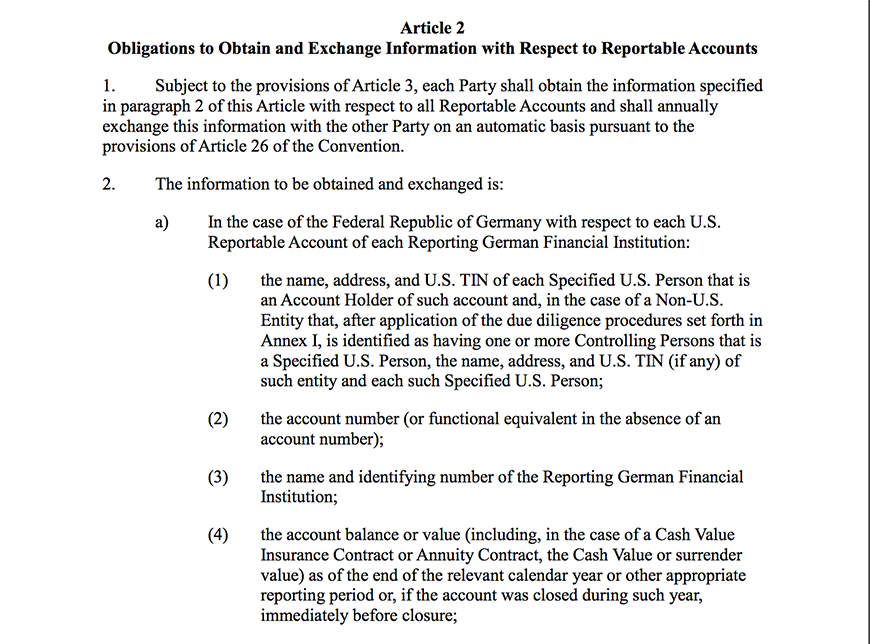
Even a quick read shows you the difference in how Article 2 is structured.
In short: the UAE and the USA signed a Model 1B IGA, under which the USA does not have to send any data to the UAE. Germany, on the other hand, agreed a Model 1A IGA with the USA, and the USA sends the corresponding data to Germany.
4How other governments were persuaded to join FATCA
Convincing other governments to sign up to FATCA turned out to be fairly easy. The FFIs themselves were willing to comply so they would not lose vital access to US markets, and they pressed their governments to play along.

Foreign governments also had their own reason to jump on the FATCA train quickly: if they received financial information on their own citizens and residents from the USA, they would suddenly have data on undeclared money hidden in America.
Somehow, the countries in this financial information game had to persuade the USA to "return the favor" with information on their taxpayers' accounts at US financial institutions.
And that is exactly how the so-called "reciprocal" Model 1 IGA came into being.
5The big losers?
In reality, the countries that signed a "reciprocal" Model 1 IGA are the big losers: their banks must send huge amounts of data on US account holders to the IRS, while their tax authorities get fairly little back from America. The data the USA sends to its FATCA partners is heavily restricted. Even a country with a reciprocal IGA, such as Germany, therefore receives no data from the USA on the controlling persons of companies, and company accounts are only reported if they are not deposit accounts and US income is credited to them.

In fact, only the following US accounts are covered by automatic exchange under FATCA:
- Bank accounts of individuals who are not US taxpayers;
- US brokerage accounts of individuals and entities that are not US taxpayers and receive US income;
However, the US government gives its "reciprocal" FATCA partners no information on the following types of accounts held at US financial institutions:
- US business accounts: US accounts held by US companies are not covered by automatic exchange of information. Nor are US accounts held by foreign companies, even when those companies are based in the FATCA partner country.
- Investment and brokerage accounts, whether held by individuals or organizations, and even if they are based in the FATCA partner country, unless income from US sources flows into these accounts (e.g. US interest and dividends). Example: a European's US brokerage account holding European shares is not reported under FATCA. A European's US brokerage account holding US shares is reported under FATCA.
On top of that, the US will not give its FATCA partners any information about the "controlling" persons of organizations that hold accounts with US financial institutions. It makes no difference at all whether the organizations come from a reciprocal partner country or from a third country, even if residents of the reciprocal partner country own and control them.
Given how little information the US shares with its "reciprocal" IGA partners, it is fairly obvious that, despite all the talk of "reciprocity", many non-Americans will keep feeling quite safe holding accounts with US financial institutions. That could mean a nice boom for the US financial market in the brave new world of financial transparency!
Here you can find out which states are especially popular with foreign investors, and why.
Everything you need to know about the different ways to transfer money between the USA and Europe is in this article. To see which countries do not take part in CRS at all, read our piece on countries without information exchange; all US tax topics are collected in our Taxes hub.
Your US tax question, answered by people who know both sides.
- The US does not take part in the OECD's Common Reporting Standard and relies on its own system, FATCA.
- Under FATCA, foreign financial institutions report the accounts of US persons: under Model 1 via their own government, under Model 2 directly to the IRS.
- Only some Model 1 agreements are reciprocal: Germany receives data from the US, the United Arab Emirates does not.
- Even to partner countries the US reports very little, for example no business accounts and no controlling persons of companies.
How we help you
- US Tax ConsultationYour US tax question, answered by people who know both sides.
- US taxes for US citizens abroadForm 1040, FBAR and Streamlined for US citizens living in Europe.
- US Bank Account OpeningYour own access to the American financial system, even without an SSN.
- Withholding taxW-8 forms, withholding and treaty benefits, done right.
More on US taxes for individuals
All articles → US tax obligations as a European: when the IRS expects a return Read more →
 Which countries don't take part in the CRS? The list, and the USA Read more →
 US Tax Season 2026: getting your US tax return done Read more →
 Substantial Presence Test: when you file 1040 or 1040-NR Read more →
 Everything you need to know about Streamlined Filing Read more →