
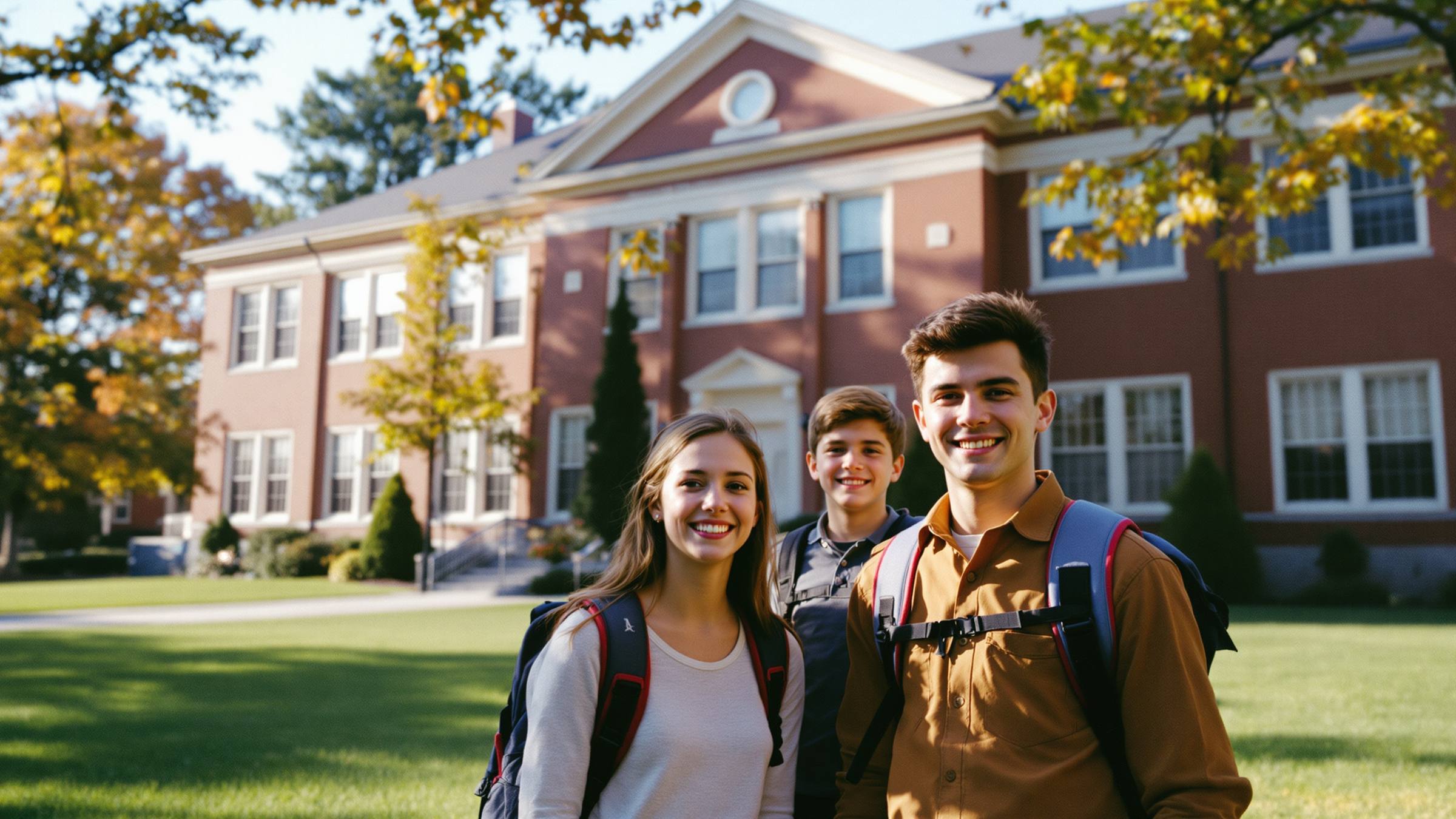
No streaming at ten, no selective school exams. Instead: a school bus and a football team.
School in the USA or back home: four paths for your child
Part of the guide Arriving in the USA: your first 90 days as a checklist
In America, all children attend the same public school system through grade 12, and the real decision comes down to your home address or to tuition.
In America, all children attend the same public school system through grade 12, and the real decision comes down to your home address or to tuition. If you move with children, you face different questions than at home: which school district, public or private, whether an international school, and how your child can later go to university in Europe. This comparison sets out the four paths. How to actually enroll your child, with documents, vaccinations and deadlines, is covered in our guide Enrolling your children in school in the USA.
1The biggest difference: no early streaming
America does it differently. Public school takes every child from kindergarten at age five through grade 12, usually in three buildings: elementary school, middle school and high school. Everyone finishes with the same qualification, the high school diploma. In Texas, the Foundation High School Program has been the standard since the 2014/15 school year (Texas Education Agency). Differences in ability show up not in the type of school but in the courses: stronger students take honors courses or Advanced Placement, AP for short, which are college-level courses with a standardized exam. AP exams are scored on a scale of 1 to 5; according to the College Board, a 5 means the student is extremely well qualified to receive college credit.
For a ten-year-old who would have been sorted into an academic track at home, that is either a relief or a frustration, depending on whom you ask. Your child stays with all the kids in the neighborhood, and the pressure of selection grades disappears. On the other hand, a lot depends on how good your local school is. And compulsory schooling lasts longer: in Texas, until the 19th birthday (Texas Education Code § 25,085).
2Path one: the public school in your district
Most American children attend public school: around 49.6 million in fall 2022, from pre-kindergarten through grade 12 (NCES, Fast Facts). There is no tuition, and the school must admit every child who lives in the district with their parents. That includes children of families on an E-2, L-1 or H-1B visa.
The catch is the variation. Public schools are run by school districts with elected school boards, and two districts in the same state can be very different. States rate their districts and schools and publish the results. How to read those ratings, and why the school district often decides where you live in America, is explained in our article on schools in the USA.
What public schools offer surprises many European parents. School buses pick children up at the curb. Sports, music and theater are part of school, not a club. In many Texas towns, the Friday night football game is the social event of the week. According to an NCES survey, in September 2023 around 51 percent of public schools offered after-school tutoring and 59 percent offered activities and clubs. In a small town, the school is the heart of the community. We wrote about what Texas education vouchers mean for these small-town schools in Education vouchers in Texas.
3Path two: charter schools, publicly funded and independently run
Charter schools are publicly funded schools run by an organization under a contract with the state, the district or another authority. The contract exempts them from some regulations; in return, the school must meet the agreed goals or risk losing its charter (NCES). Between fall 2010 and fall 2021, charter school enrollment more than doubled from 1.8 to 3.7 million, and their share of all public school students rose from 4 to 7 percent. In the 2021/22 school year, there were around 7,800 charter schools in the USA.
For newly arrived families, charter schools are attractive because they often have a clear focus, such as science, classical education or a second language, and because they charge no tuition. They are not tied to district boundaries. Each school sets its own rules on available places and how they are allocated. Ask early about deadlines: they often fall before your moving date.
Visa, bank account, taxes and where to live: your move with Mount Bonnell Advisors.
4Path three: private school, and who helps pay for it in Texas and Florida
Around 5.5 million children attended a private school from kindergarten through grade 12 in fall 2021 (NCES, Fast Facts). The range runs from church parish schools through Montessori and Waldorf schools to boarding schools with their own paddocks. Each school sets its own tuition and largely decides its own curriculum; Florida, for example, states in law that the state does not control private school curricula (Florida Statutes § 1003.21(1)(b)). Quality and reputation therefore depend on the school itself and on its accreditation by a recognized association. That accreditation is no minor detail: it later determines whether the diploma is recognized back home.
Texas and Florida pay families money toward private school. In Texas, the program is called Texas Education Freedom Accounts. For the 2026/27 school year, a child at an approved private school receives $10,474, which under state law is 85 percent of average state and local funding per public school student. Children with disabilities and an individualized education plan can receive up to $30,000, and homeschooled children $2,000 a year. Eligible children are US citizens or lawfully present in the USA and eligible to attend a Texas public school; the parents must live in Texas. That includes families on an E-2 or L-1 visa. The application window for 2026/27 ran from February 4 to March 31, 2026, and more than 274,000 applications came in (Texas Comptroller, FAQ). So if you move in the summer, you will usually have missed the window for your first school year.
Florida awards the Family Empowerment Scholarship to children who live in Florida and are eligible to attend a public school from kindergarten through grade 12. Priority goes to households with income up to 185 percent of the poverty line, then to households up to 400 percent (Florida Statutes § 1002.394(3)).
If neither public nor private school suits you, Texas still has homeschooling, with very few requirements. How it works is covered in our guide Homeschooling in the USA and in the overview of twelve states.
| Texas: Education Freedom Accounts | Florida: Family Empowerment Scholarship | |
|---|---|---|
| Who qualifies | Children who are US citizens or lawfully present in the USA and eligible to attend a Texas public school; parents live in Texas | Children who live in Florida and are eligible to attend a public school from kindergarten through grade 12 |
| Amount | $10,474 per child at an approved private school in the 2026/27 school year; up to $30,000 for disabilities with an education plan; $2,000 for homeschooling | Calculated under state law |
| Priority | If funds run short, a lottery decides, with priority for children with disabilities and by income (up to 200, then up to 500 percent of the poverty line); application window for 2026/27 from February 4 to March 31, 2026 | First households up to 185 percent of the poverty line, then up to 400 percent |
Sources: Texas Comptroller of Public Accounts, Texas Education Freedom Accounts, FAQ; Florida Statutes § 1002.394(3) (version 2026). Accessed 24 October 2026.
5Option four: international schools
In the US, international schools are usually private schools, often offering the International Baccalaureate or a bilingual track. They make the most sense for families who are staying only a few years or whose children have already changed schools before. A program that is recognized internationally makes the next move easier, whether back to Europe or on to a third country.
| Type of school | Students | As of |
|---|---|---|
| Public schools, pre-K to grade 12 | about 49.6 million | Fall 2022 |
| of which public charter schools | about 3.7 million, 7 percent of all public school students | Fall 2021 |
| Private schools | about 5.5 million | Fall 2021 |
Sources: National Center for Education Statistics, Fast Facts: Back-to-school statistics; NCES, Public Charter School Enrollment (May 2023). Accessed 24 October 2026.
7Which option fits your family
The right school comes down to three questions. How long are you staying? If you're staying for good, a good public school is usually the best choice: your kids make friends in the neighborhood, and it's free. If you're staying only a few years, plan for the move back from day one. Where do you want to live? In America, the school follows your address, so the school question belongs at the start of your house hunt, not the end. For places worth considering, read Where in America is the best place to live?. And what matters to you? If it's language, religion or a particular teaching approach, you're more likely to find it at a charter or private school.
Our recommendation for families who truly want America is Texas: a big market of public and private schools, state money for private school, and plenty of freedom for families who homeschool. For how settling in works overall, from day one to month three, see the checklist Arriving in the USA.
One hour with the firm: your case, your questions, a clear answer.
- In the US, all children stay in the same public system through grade 12 and earn the same diploma.
- About 49.6 million children attend public schools and about 5.5 million attend private schools. Charter schools are publicly funded but independently run.
- For the 2026/27 school year, Texas pays families who are lawfully in the country up to $10,474 per child for private school; Florida awards scholarships to all school-age children, with priority by income.
How we help you
More practical guides: settling in the USA
All articles → Enrolling Your Children in School in the USA: Your Address Decides Read more →
 Schools & education: the best universities in the world, but... Read more →
 Homeschooling in the USA Read more →
 Arriving in the USA: your first 90 days as a checklist Read more →
 Where in America is life best? Read more →
 Financial planning: credit score & credit history Read more →