
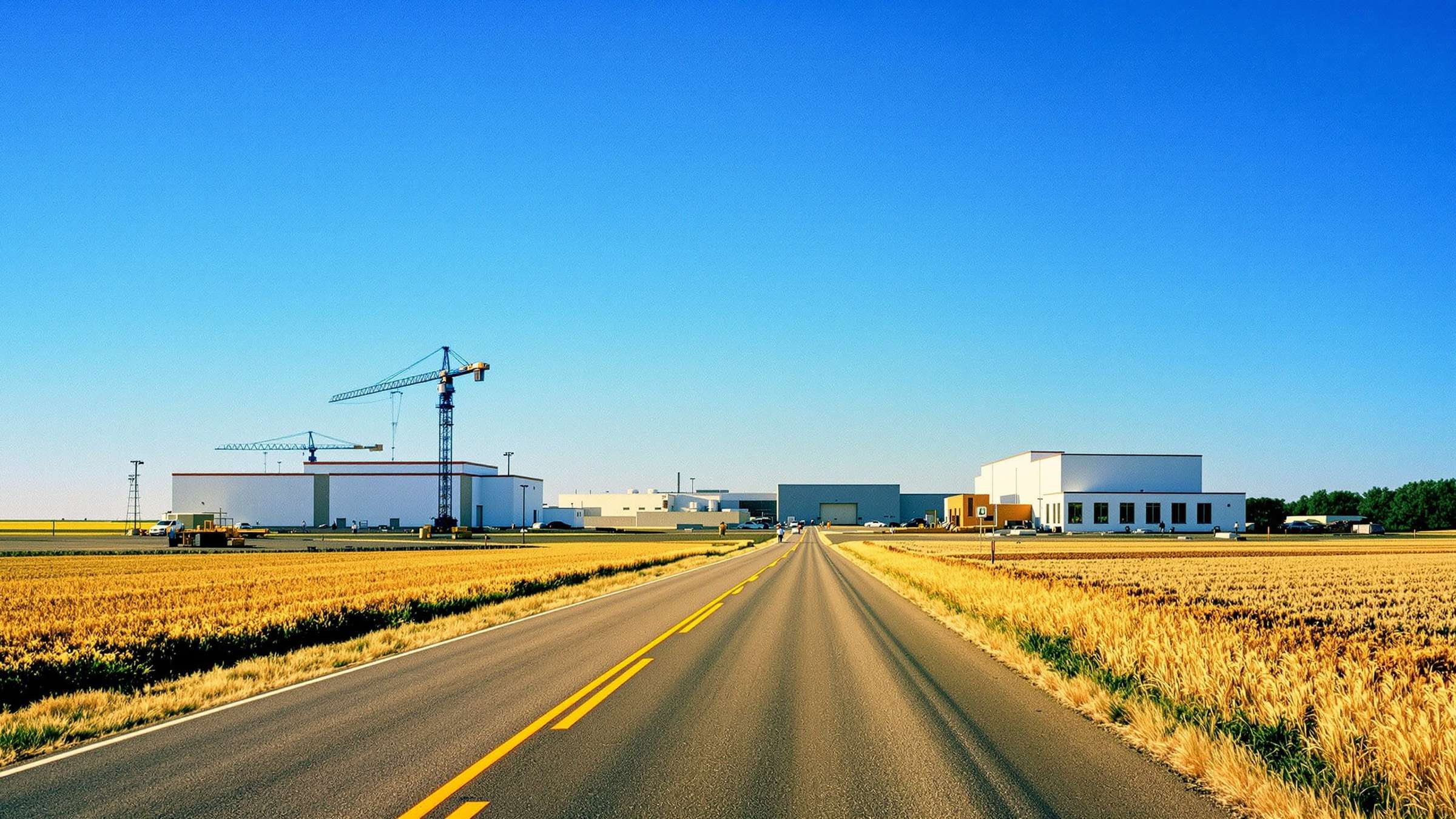
Where the metro area ends, the discount begins. And so does a separate line.
EB-5 in TEAs and rural areas: a quarter less capital
Part of the guide The US EB-5 visa: the green card for investors
The EB-5 has two prices for the same green card. Invest in a project in a rural area or a high unemployment area and you need roughly a quarter less capital. On top of that, the law reserves separate visa quotas, and rural projects move to the front of the line at the immigration agency. No wonder almost every project a Regional Center offers you claims exactly this status.
This guide explains what a Targeted Employment Area (TEA) is, who decides, how the reserved visas work and which questions to ask a project before your money moves. For an overview of the whole process, see the guide to the EB-5 investor visa.
1What a TEA is and what it saves you
The standard EB-5 amount is $1,050,000. Invest in a TEA, or through a Regional Center in an infrastructure project, and you need $800,000, which is $250,000 less. Both amounts are set by statute, 8 U.S.C. § 1153(b)(5)(C), and apply to petitions filed on or after March 15, 2022 (before that, they were $1,000,000 and $500,000). The green card at the end is the same. Only the road there is cheaper.
Under the law, a TEA is one of two things at the time of investment: a rural area or an area the Department of Homeland Security has designated as a high unemployment area. USCIS, the immigration agency, acts for the Department.
One figure from the Department itself shows how much the lower amount shapes the market. Of 50,766 Regional Center investments in fiscal years 2016 through 2025, 50,703 were made at the reduced amount. So the question is rarely whether a project claims the discount. The question is whether the claim holds up.
1.1Where the project operates, not where the company is registered
The lower amount applies only if the business you invest in principally does business in the TEA. For a Regional Center investment, what counts is the business that creates the jobs, the job-creating entity. USCIS looks at where the directly created jobs are, where the job-creating expenditures happen, where day-to-day operations take place and where the assets are used. So a fund with an office in a big city can invest in a rural factory. Conversely, a rural address does nothing for you if the work happens in the city.
1.2The amounts change in 2027
Starting January 1, 2027, the law adjusts the standard amount every five years for consumer prices (CPI-U), rounded down to the nearest $50,000. The TEA and infrastructure amount is then 75 percent of the standard amount. What matters is the date your petition is received. The Department publishes the new figures as a technical amendment in the Federal Register; as of this guide in October 2026, it had not appeared. More in the guide to the EB-5 investment amount.
| Investment | Minimum amount | Who determines it qualifies | Route |
|---|---|---|---|
| Standard (no TEA, no infrastructure project) | $1,050,000 | not applicable | Direct investment or Regional Center |
| TEA: rural area | $800,000 | USCIS, based on the statutory definition; never a state | Direct investment or Regional Center |
| TEA: high unemployment area | $800,000 | the Department of Homeland Security alone (USCIS) | Direct investment or Regional Center |
| Infrastructure project | $800,000 | the Department of Homeland Security alone, when reviewing Form I-956F | Regional Center only |
| Petitions before March 15, 2022 | $1,000,000, in a TEA $500,000 | back then also the states (high unemployment only) | both |
Source: 8 U.S.C. § 1153(b)(5)(B) and (C); USCIS, About the EB-5 Visa Classification (as of November 18, 2025); USCIS Policy Manual, Volume 6, Part G, Chapter 2, Sections A.5 and A.6 (as of October 23, 2026). From January 1, 2027, the amounts adjust for petitions filed from then on.
2Rural area: everything outside the metro areas
The law defines rural by what it is not. A rural area is any area that meets two conditions at once: it is not in a Metropolitan Statistical Area (MSA) as defined by the Office of Management and Budget, and it is not within the outer boundary of a city or town with 20,000 or more residents according to the most recent census. The most recent is the 2020 census; the next comes in 2030.
2.1An MSA is bigger than you think
An MSA is made up of whole counties. At its core is at least one urban area with 50,000 residents, plus surrounding counties tied to the core by commuting. As of July 2023, the Census Bureau counts 387 MSAs. So a field at the far edge of such a county is not rural for EB-5 purposes, even if cows graze there and the nearest traffic light is twenty miles away.
The 538 Micropolitan Statistical Areas, with a core of between 10,000 and 50,000 residents, are different. They are not MSAs. A project there can be rural, as long as it is not within the boundary of a city with 20,000 or more residents. The two tests go together: a small town of 25,000 residents outside any MSA is not rural within its city limits, but the business park just beyond them may well be.
2.2No state can make an area rural
There has never been a process for a state to designate rural areas. Proof is a matter of geography: the project lies outside every MSA and outside every city with 20,000 or more residents. For Regional Center projects, the Regional Center submits a map or other depiction of the project area in the project application, Form I-956F. A Department proposal from July 2026 would write the definitions into federal regulations and require a map with population figures for rural areas; the comment period ended August 31, 2026, and the proposal is not in force.
Rural projects have two advantages that high unemployment areas lack: the largest quota of reserved visas and statutory priority in processing. Both are covered below.
3High unemployment: census tracts and the 150 percent threshold
The second type of TEA is the high unemployment area. Since the EB-5 Reform and Integrity Act of 2022, only the Department of Homeland Security designates these areas. Until then, states could name them. For petitions filed on or after March 15, 2022, the law bars any other federal official and any state or local official from making the designation. So a letter from a state capital no longer replaces a USCIS decision.
3.1How the area is drawn
The building blocks are census tracts, small statistical districts of the Census Bureau. The area consists of the tract or contiguous tracts where the business principally operates. If that is not enough, the Department may add directly adjacent tracts, but only those, no chain across three districts. A weighted unemployment rate is calculated for the whole area, weighted by the labor force in each tract. It must reach at least 150 percent of the national rate. An example: if the national rate were 4 percent, the area would need at least 6 percent.
The data must match. If you use the Census Bureau's American Community Survey for the tracts, the Policy Manual says you also use the American Community Survey for the national average. For a Regional Center project, the list of tracts and the calculation go in Form I-956F. If you invest directly, you supply both with your own petition, Form I-526, and USCIS decides case by case.
3.2Two years, then it must be renewed
A designation is valid for two years: for Regional Center projects from the day Form I-956F was filed, for direct investments from the date of investment. It can be renewed for two years at a time if the area still meets the threshold. USCIS recommends requesting renewal by email at least 90 days before expiry; there is no fee.
For you as an investor, one sentence in the law is crucial. If you invested the TEA amount while the designation was valid, you do not have to top up if it later expires. But if you only subscribe, or have not paid in full, when the designation ends and the Regional Center does not request a renewal, you may need the standard amount. Unless the project is also rural or an infrastructure project.
| Feature | Rural area | High unemployment area |
|---|---|---|
| Standard | outside every MSA and outside every city with 20,000 or more residents (census) | weighted unemployment rate of at least 150 percent of the national average |
| Area | Location of the project relative to MSAs and city limits | Census tract or contiguous tracts in which the business principally operates, plus directly adjacent tracts |
| Who decides | USCIS, based on the evidence | The Department of Homeland Security alone, by designation |
| Evidence filed by the Regional Center | Map or other depiction of the project area in Form I-956F | List of tracts and unemployment rate calculation in Form I-956F |
| Validity | Location as of the key date; no designation that expires | Two years from filing of the I-956F (for direct investment, from the investment), renewable for two years at a time |
| Reserved visas | 20 percent | 10 percent |
| Priority processing | Yes, by statute for Regional Center petitions | no |
| Must still apply at the I-829 stage | no | no |
Source: 8 U.S.C. § 1153(b)(5)(B), (D)(vii), (D)(viii), (E)(ii); USCIS Policy Manual, Volume 6, Part G, Chapter 2, Section A.5, and Chapter 5, Sections B.6 and B.7 (as of October 23, 2026); USCIS, EB-5 Questions and Answers (as of April 20, 2026).
4Infrastructure projects: the third route to the lower amount
Since May 2022 there has been a third way to qualify with $800,000: an infrastructure project. The law defines this as a project run by a government entity, such as a federal, state or local agency. That entity is itself the job-creating business and receives capital through a Regional Center to maintain, improve or build a public works project. A private developer who helps build a road does not turn its project into an infrastructure project.
Two limits apply. Infrastructure is open only to investors going through a Regional Center; if you invest directly, you cannot rely on it. And whether a project meets the definition is decided solely by the Department, when it reviews Form I-956F. In its July 2026 proposal, the Department lists the sectors where it expects such projects: aviation, broadband, drinking water, power transmission, energy generation, pipelines, ports, stormwater and wastewater, roads, bridges, rail and public transit, and water resources. 2 percent of EB-5 visas are reserved for infrastructure.
In writing: which visa fits you and your family, prepared with the immigration attorney on the firm's team.
520, 10 and 2 percent: the reserved visas
The EB-5 program receives 7.1 percent of employment-based immigrant visas. According to USCIS, that is about 10,000 visas per fiscal year, including spouses and unmarried children under 21. A family with two children therefore uses four of them. Based on the statutory minimum of 140,000 employment-based visas, the math comes to 9,940.
Since 2022 the law has set aside part of these: 20 percent for investments in rural areas, 10 percent for high-unemployment areas and 2 percent for infrastructure projects. The Department puts this at about 1,988 rural visas and about 994 high-unemployment visas in a typical year. The remaining 68 percent are open to all other investors, including those investing the standard amount.
5.1What happens to unused visas
If reserved visas are left over at the end of a fiscal year, they remain available to the same category the following year. If they still go unused, they move to the unreserved EB-5 visas in the third year. The federal fiscal year runs from October 1 to September 30.
Rural and high-unemployment areas are open to both routes, direct investment and Regional Center. Infrastructure is available only through a Regional Center. The Visa Bulletin lists two codes each for the first two and just one for infrastructure. For visas through the Regional Center Program, the law runs until September 30, 2027. What this means for choosing your route is covered in the guide Regional Center or direct investment.
| Category | Weight | Approx., in a year with 9,940 EB-5 visas | Visa Bulletin codes |
|---|---|---|---|
| Rural area | 20 % | 1.988 | NR, RR |
| High unemployment | 10 % | 994 | NH, RH |
| Infrastructure | 2 % | 199 | RI |
| Unreserved | 68 % | 6.759 | C5, T5, I5, R5, NU, RU |
| Total | 7.1% of employment-based visas | 9.940 |
Source: 8 U.S.C. § 1153(b)(5)(A) and (B)(i); Visa Bulletin for November 2026, Section A (at least 140,000 employment-based visas); Department of Homeland Security, Federal Register 2026-13392 of July 2, 2026 (about 1,988 and 994 in a typical year). Infrastructure and unreserved: our own calculation. Spouses and children are included.
6What the Visa Bulletin shows for Europeans
Whether a visa is available is shown in the U.S. State Department's Visa Bulletin, published fresh every month. You are generally charged to your country of birth, not your passport. If you were born in Norway, Sweden, Denmark, Finland, the UK, Ireland or the Netherlands, you fall under the column for all countries not listed separately. China (mainland), India, Mexico and the Philippines have their own columns.
In the November 2026 bulletin, every EB-5 category in that column was marked C, for current: no cutoff date, for either the unreserved or the reserved visas. Cutoff dates applied only to people born in China and India, in the unreserved category. For them, the reserved quotas work like a fast lane, because all three of those categories were current.
What this means for you: that month, a TEA gave you no head start in the Visa Bulletin, because applicants from Europe had no line to skip. The advantage was the lower amount and, for rural projects, priority processing. A C is a snapshot. How priority dates and the Visa Bulletin work together is explained in the guide to processing times, the Visa Bulletin and priority dates.
| Category | All other countries (including Europe) | China (mainland) | India | Mexico | Philippines |
|---|---|---|---|---|---|
| Final Action Date: unreserved | C | 01DEC16 | 01DEC23 | C | C |
| Final Action Date: rural, high unemployment, infrastructure | C | C | C | C | C |
| Date for Filing: unreserved | C | 01MAR21 | 01MAY24 | C | C |
| Date for Filing: rural, high unemployment, infrastructure | C | C | C | C | C |
Source: U.S. Department of State, Visa Bulletin for November 2026, Sections A and B of the employment-based tables. C stands for current: there is no cutoff date for that category this month. The bulletin is published fresh every month.
7Priority processing for rural projects at USCIS
The law requires the Department to give priority to petitions from Regional Center investors in rural areas. USCIS has turned this into a processing order that has applied since March 30, 2026. A Form I-526E petition is only taken up once the related project application, Form I-956F, has been decided. Rural I-526E petitions are then handled first, in order of receipt, with an eye to the rural visas expected to be needed in the current fiscal year. The remaining petitions follow once that queue is empty or USCIS has decided enough rural cases. Within the remaining petitions, USCIS may sort by category: high unemployment, infrastructure, unreserved.
This has a practical consequence. A rural project only moves you up the line once its project application has been decided. A project whose I-956F is still pending holds up your petition too.
The law also sets targets for average processing times, which the Department uses to set its fees. For TEA projects they are shorter than for all others. Targets are not promises for any individual case. The steps from project application to green card are covered in the guide to the process with I-526E, consulate or adjustment, and I-829.
| Application | Target |
|---|---|
| Regional Center application or project application (Form I-956F) | 180 days |
| Project application (Form I-956F) for a business in a TEA | 90 days |
| Regional Center investor petition (Form I-526E) or petition to remove conditions (Form I-829) | 240 days |
| Regional Center investor petition for an investment in a TEA | 120 days |
Source: Department of Homeland Security, EB-5 Fee Rule, Federal Register 2026-20016 of September 30, 2026 (effective November 30, 2026), section explaining the fees. The figures are targets for average processing, not deadlines for any individual case.
8The key date: when an area has to be a TEA
Unemployment rates fall, small towns grow. An area that was a TEA three years ago may not be one today. That is why the right date matters.
For Regional Center petitions filed on or after March 15, 2022, USCIS reviews the TEA as part of the project application, Form I-956F. If you invest directly, the review happens in your own petition: if the money was invested before the petition, the investment date counts; otherwise the petition date. You cannot rely on earlier decisions for other investors in the same business if the facts have changed since.
If the area is a TEA at the relevant time, that holds for you. When you file Form I-829 to request removal of the conditions on your green card, you do not have to show that the area is still a TEA. The Policy Manual explains this with the program's purpose: if new jobs bring unemployment down, the investment has worked. Likewise, a business may redeploy capital it gets back after creating the jobs outside a TEA.
Find the right path to the USA for you in one conversation.
9Vetting a TEA project: seven questions before you wire the money
A project's brochure states the category. Whether it holds up is for USCIS to decide. These questions help you test the claim first.
- Which category does the project claim? Rural, high unemployment or infrastructure. This determines your visa allocation and your place in line at USCIS, not just the amount.
- Where does the project application stand? Filed, decided or still being prepared? Without an approved Form I-956F, your petition will not be processed.
- For high unemployment: when does the designation expire? Work backwards to see whether you can be fully invested before then, and ask whether the Regional Center is applying for an extension.
- For rural projects: is the job-creating business really outside every MSA? What counts is the county where construction and work take place, not where the fund is based.
- Where are the jobs created, and where does the money go? Both must be inside the TEA, or the lower amount does not apply.
- What does access cost? Regional Centers charge an administrative fee which, according to the government, is usually 10 percent of the investment amount. Every item is covered in the guide to EB-5 total costs.
- Can you document where your money comes from? The lower amount does not change the requirement to prove the source and path of every dollar. The guide to source of funds explains how.
If you would rather build your own business in a TEA, the direct investment route applies: rural or high unemployment areas qualify, infrastructure does not, and your business must create the ten full-time jobs itself, whereas Regional Center investors may cover up to 90 percent through indirect jobs. If you want to run your own business and don't need a green card to get started, read the comparison E-2 visa or EB-5 green card before choosing a path.
- A TEA is a rural area or an area of high unemployment designated by the Department of Homeland Security. There, and for infrastructure projects through a Regional Center, the minimum investment drops from $1,050,000 to $800,000; the amounts adjust from 2027.
- Rural means outside any Metropolitan Statistical Area and outside any city with 20,000 or more residents. High unemployment means at least 150 percent of the national rate in the project's census tracts.
- 20 percent of EB-5 visas are reserved for rural projects, 10 percent for high unemployment areas and 2 percent for infrastructure. USCIS gives priority processing to rural Regional Center petitions.
- For applicants from Europe, the November 2026 Visa Bulletin showed all EB-5 categories as current.
- A high unemployment designation is valid for two years. If you are not fully invested by then and there is no extension, you may need to invest the standard amount.
How we help you
More on US visas
All articles → EB-5 investment amount: $800,000 or $1,050,000, and what counts Read more →
 EB-5 regional center or direct investment: who carries the risk? Read more →
 E-2 visa or EB-5 green card: which is better? Read more →
 US EB-5 visa: the green card for investors Read more →
 The EB-5 process: from I-526E to I-829 in four stages Read more →
 EB-5 processing time: a 240-day target, then the queue Read more →