
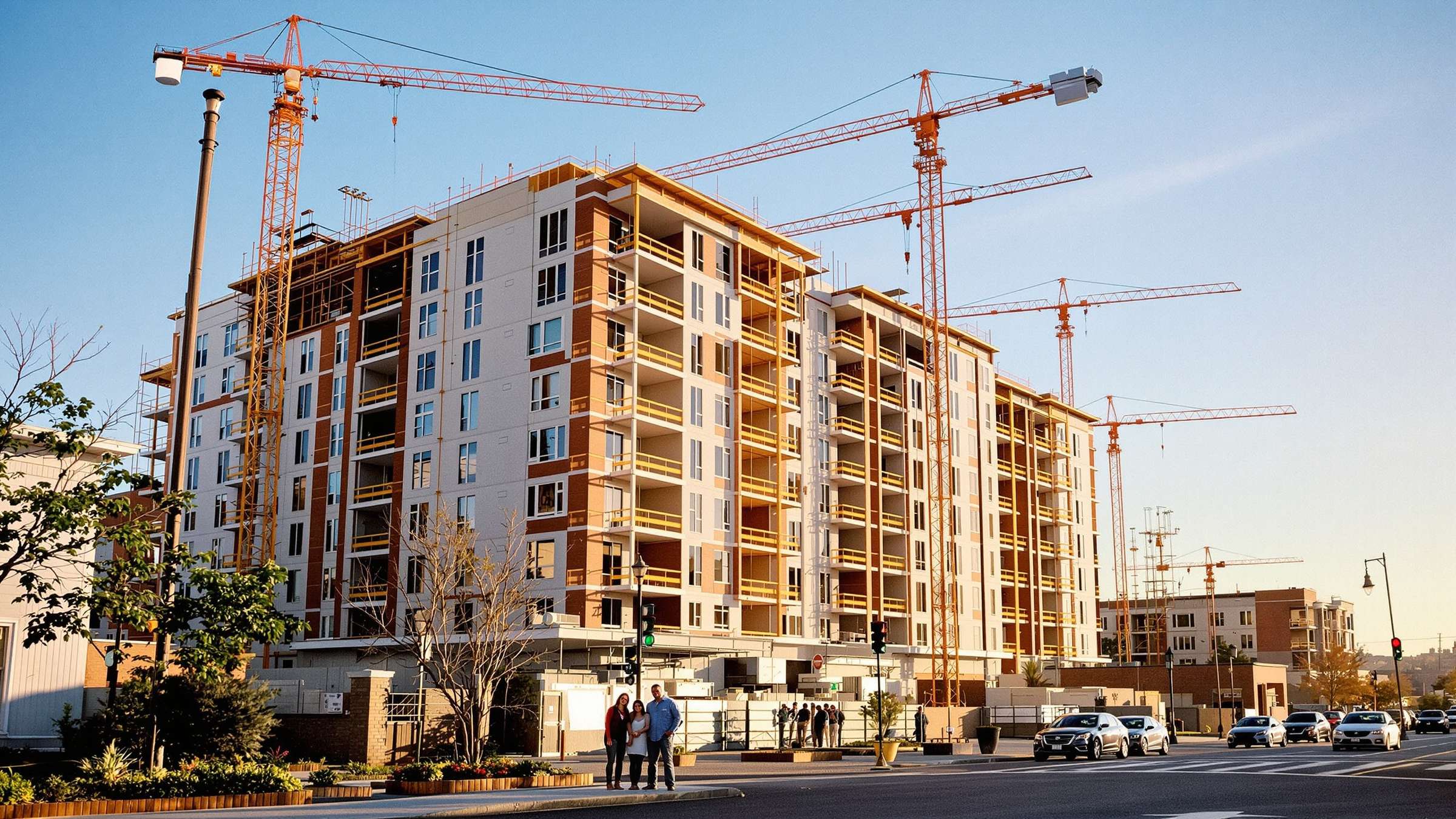
A million dollars is wired in minutes. The green card comes in stages.
The EB-5 process: from the I-526E to the I-829 in four stages
Part of the guide The US EB-5 visa: the green card for investors
The EB-5 route has four stages, each with its own form, its own agency and its own deadline. Know the order, and you can plan your capital, your move and your family so that no stage holds up the next.
When people think about the EB-5 green card, they usually think about the amount first. That's understandable: we're talking about $1,050,000 or, in a targeted employment area, $800,000. But the money is only the beginning. Four stages follow at two different agencies, and several years pass between the first wire transfer and the permanent green card. This guide walks through the stages in order: what happens in each, which form belongs to it, which deadline is running and where families from Europe typically trip up.
| Stage | Form | Who decides | When |
|---|---|---|---|
| 1. Investor petition | I-526E (through a Regional Center) or I-526 (direct investment) | USCIS | once the capital is invested or actively being invested |
| 2a. Immigrant visa from abroad | DS-260 | State Department, consulate | after the petition is approved, when a visa is available |
| 2b. Adjustment of status in the US | I-485 | USCIS | with, during or after the petition, when a visa is immediately available |
| 4. Removal of conditions | I-829 | USCIS | in the 90 days before the second anniversary |
Source: USCIS, EB-5 Immigrant Investor Process (page as of November 18, 2025); 8 U.S.C. § 1186b(d)(2). Accessed October 24, 2026.
1Before the first form: project, capital, source of funds
The first form an investor files with USCIS is the petition. Before you can file it, though, you need to know what you are investing in. This is where the road splits into two tracks.
The first track is the Regional Center. A Regional Center is an organization designated by USCIS that pools the capital of several investors in one project. The Regional Center gets the project itself approved in advance with Form I-956F. For you, that means you invest in a company that passes the money on to a project, and up to 90 percent of the ten jobs the law requires per investor may be created indirectly, at suppliers and service providers around the project.
The second track is direct investment. You start or buy a business and invest in it yourself. In that case, the ten full-time jobs must be created directly in that business, on its own payroll. Which track suits you is covered in the guide Regional Center or direct investment.
The same ground rule applies on both tracks: the capital must be at risk. A guaranteed return or a contractual right to get the money back on a fixed date disqualifies the investment. And it must come from a lawful source that you document without gaps, from the earnings or sale all the way to its arrival in the US company's account. This paperwork is the most demanding part of the whole preparation, and it doesn't come together in the week before you file. What it looks like is explained in the guide to source of funds. Which amount applies to you is set out in the guide to the investment amount.
2Stage one: the I-526E or I-526 petition
With the petition, you ask USCIS to classify you as an investor in the fifth employment-based category. If you invest through a Regional Center, you use Form I-526E. If you invest directly, you use Form I-526. The distinction is strict: USCIS rejects an I-526 if the investment is tied to a Regional Center.
The petition must include everything that supports your eligibility. That means proof that you have invested or are actively investing, the path of the money from its source to the company, the company's documents and, for a direct investment, a business plan that makes the ten jobs credible. With a Regional Center, the project sponsor supplies most of the project documents. Nobody supplies your own source-of-funds documents for you.
What matters is the date USCIS receives your complete, signed petition. That is your priority date, your place in line for the annually capped EB-5 visas. How that line works and what the monthly Visa Bulletin has to do with it is explained in the guide to processing times.
A practical detail from the USCIS instructions: if you file the petition together with other forms, such as the I-485, you pay each fee separately. A single combined payment for several forms gets the whole package sent back.
3Stage two: consulate or adjustment of status
Once the petition is approved, there are two routes to the green card. Which one applies to you depends on where you are.
3.1From abroad: the immigrant visa
If you live in Europe, you apply to the State Department for an immigrant visa using the online Form DS-260. The National Visa Center collects the documents as soon as your turn in line comes up and passes the case to the responsible consulate. Every applicant, every child included, needs a medical exam with a physician approved by the consulate. Then comes the in-person interview.
The immigrant visa is valid for six months at most. You must enter the US within that time. Your conditional green card begins the day you enter. For the card itself, you pay USCIS the Immigrant Fee of $235 per person.
3.2From inside the US: adjustment of status
If you are already lawfully in the US, for example on an E-2 or an L-1, you can adjust your status there with Form I-485. The law allows you to file the I-485 together with the petition, while it is pending or after it is approved, provided a visa is immediately available to you. While the I-485 is pending, you can apply for a work permit (I-765) and a travel permit (I-131, Advance Parole).
Two rules belong at the start of any plan. If you entered on ESTA, you generally cannot adjust your status. And if you leave the country while your I-485 is pending without first getting Advance Parole, you abandon your application. The exception applies only to H-1 and L-1 holders, not to the E-2. All the details are in the guide to concurrent filing and switching from the E-2.
| Form or fee | until November 29, 2026 | postmarked from November 30, 2026 |
|---|---|---|
| I-526 (direct investment) | $3,675 | $7,615 |
| I-526E (Regional Center), initial filing | $3,675 plus $1,000 Integrity Fund | $7,850 plus $1,100 Integrity Fund |
| I-829 (removal of conditions) | $3,750 | $5,000 |
| I-485 (adjustment of status), per person aged 14 and over | $1,440 on paper, $1,390 online; children under 14 filing with a parent $950 or $900 | |
| I-765 (work permit) with a pending I-485 | $260 | |
| I-131 (Advance Parole) with a pending I-485 | $630 on paper, $580 online | |
| Immigrant visa at the consulate, per person | $345 | |
| USCIS Immigrant Fee after visa issuance, per person | $235 | |
Source: USCIS, Form G-1055 Fee Schedule, edition 10/16/26; Federal Register 2026-20016 of September 30, 2026 (EB-5 Fee Rule, effective November 30, 2026); 22 CFR 22.1, item 32(b). Accessed October 24, 2026.
In writing: which visa fits you and your family, prepared with the immigration attorney on the firm's team.
4Stage three: two years of conditional green card
Whether through the consulate or the I-485, what you get at the end is not an ordinary green card but a conditional one. From day one, the law treats you, your spouse and your children as lawful permanent residents, but subject to a condition that lasts two years. The card expires on the second anniversary.
With the conditional green card, you may live, work, run businesses and travel in the US. And the time already counts toward later naturalization. What it does not allow is taking the capital out of risk. For petitions filed on or after March 15, 2022, the law requires the capital to remain invested for at least two years, and at the I-829 stage USCIS checks whether you held the investment the whole time.
In this phase, you usually see little of the process and a lot of the project. That is exactly what makes it risky, because what happens in the project decides stage four. What to watch and what records to keep during these two years is covered in the guide to the conditional green card.
5Stage four: the I-829 and the permanent green card
With Form I-829, you apply to have the conditions removed. The window is narrow: the petition must be filed in the 90 days immediately before the second anniversary of your conditional green card. File earlier, and USCIS may reject it. Don't file at all, and your status ends by operation of law on the second anniversary. USCIS accepts a late petition only if you show good cause and extraordinary circumstances.
With Form I-829 you show two things: that you invested the capital and kept it invested, and that the business created at least ten full-time jobs or will create them within a reasonable time. The law provides for a personal interview, which USCIS may waive at its discretion.
Once the petition is received, the receipt notice extends the validity of your card by 48 months beyond the expiry date printed on it. Carry the notice together with your card: it proves your status when you enter the country and to your employer. If the I-829 is approved, you receive the permanent green card, and so do the family members who came with you.
6Your family in the process
Your spouse and your unmarried children under 21 get their green cards through your petition. They need no investment of their own and no I-526E of their own. They do need their own applications in the second stage, though: their own DS-260 at the consulate or their own I-485 in the US, each with its own fee. So the costs grow with your family, but the investment does not.
On the I-829 you can include your spouse and children in your petition. From November 30, 2026, the regulation makes it explicit that you can also include a child who turned 21 or married during the two years. Any family member you do not include files their own petition within the same window.
Because children only count as children until their 21st birthday, your oldest child's date of birth belongs in the very first round of planning. It helps decide whether the consular route or the I-485 is faster.
7The dates you cannot move
Beyond the deadlines in your own case, some dates apply to every investor. You should know four of them before you draw up a timeline.
November 30, 2026: From this day, the new EB-5 fee schedule applies to all applications postmarked on or after this date. The I-526 petition then costs $7,615, the I-526E $7,850 plus $1,100 for the Integrity Fund, and the I-829 $5,000. Until then, the lower fees in the table above apply.
January 1, 2027: By law, the minimum amounts of $1,050,000 and $800,000 adjust for inflation for petitions filed on or after this day, and every five years after that. USCIS publishes the new amounts. If you are filing shortly before this date, keep this in mind.
September 30, 2026: For Regional Center petitions filed by this day, the law requires USCIS to keep processing them even if the program lapses. Petitions filed later do not get this protection.
September 30, 2027: The Regional Center Program is authorized by law until this day. Whether it is extended is up to Congress. The direct investment route does not depend on this date.
Find the right path to the USA for you in one conversation.
8What happens back home at the same time
The US process has a counterpart at home. With a green card you become a US tax resident, taxed on your worldwide income. The IRS calls this the green card test, and it applies from the first day you are in the country as a lawful permanent resident. So if you are entering on an immigrant visa, get your assets in order before you go, not afterwards.
Whether the EB-5 is the right route at all is the question that comes before every stage. For many entrepreneurs, an E-2 or an L-1 is the faster way into the US, with a later switch to a green card. You will find the comparison under E-2 visa or EB-5 green card, and the total cost of the EB-5 in our guide to EB-5 costs. The Visa Roadmap sets out in writing which routes are open to you and your family, in what order and with which documents.
- The EB-5 process has four stages: the petition (I-526E through a Regional Center or I-526 for a direct investment), the immigrant visa at the consulate or adjustment of status with the I-485, two years on a conditional green card, and the I-829.
- The date USCIS receives your complete petition is your priority date, and it sets your place in the queue.
- If you are already lawfully in the US, you can file the I-485 together with the petition when a visa is immediately available. If you entered on ESTA, you cannot.
- The I-829 must be filed in the 90 days before the second anniversary of your conditional green card. Miss that window and you lose your status.
- Higher USCIS fees apply to applications postmarked on or after November 30, 2026, and adjusted investment amounts from January 1, 2027.
How we help you
- Visa RoadmapIn writing: which visa fits you and your family, prepared with the immigration attorney on the firm's team.
- Visa and Green Card ConsultationWhich route to the USA fits you, settled in one conversation.
- Moving to the USAVisa, bank account, taxes and where to live: your move with Mount Bonnell Advisors.
- Tax structureA clean structure between parent company and US subsidiary, or between you and your US company, coordinated with your accountant.
More on US visas
All articles → EB-5 processing time: a 240-day target, then the queue Read more →
 The conditional green card in the EB-5: two years on probation and the I-829 Read more →
 Concurrent filing in the EB-5: from the E-2 in America to a green card Read more →
 US EB-5 visa: the green card for investors Read more →
 Green card through investment: capital at risk for ten jobs Read more →
 Source of funds in the EB-5: tracing every dollar to its origin Read more →