"Just a quick trip over", and suddenly HSI is at the gate
475 arrests at Hyundai in Georgia: the largest HSI raid in US history. Many of those detained had entered on a B-1 or even ESTA. A wake-up call for every company: meetings and training are allowed, productive work is not. If you don't separate "watching" from "delivering output" now, you risk a site shutdown, losses in the millions and criminal proceedings.
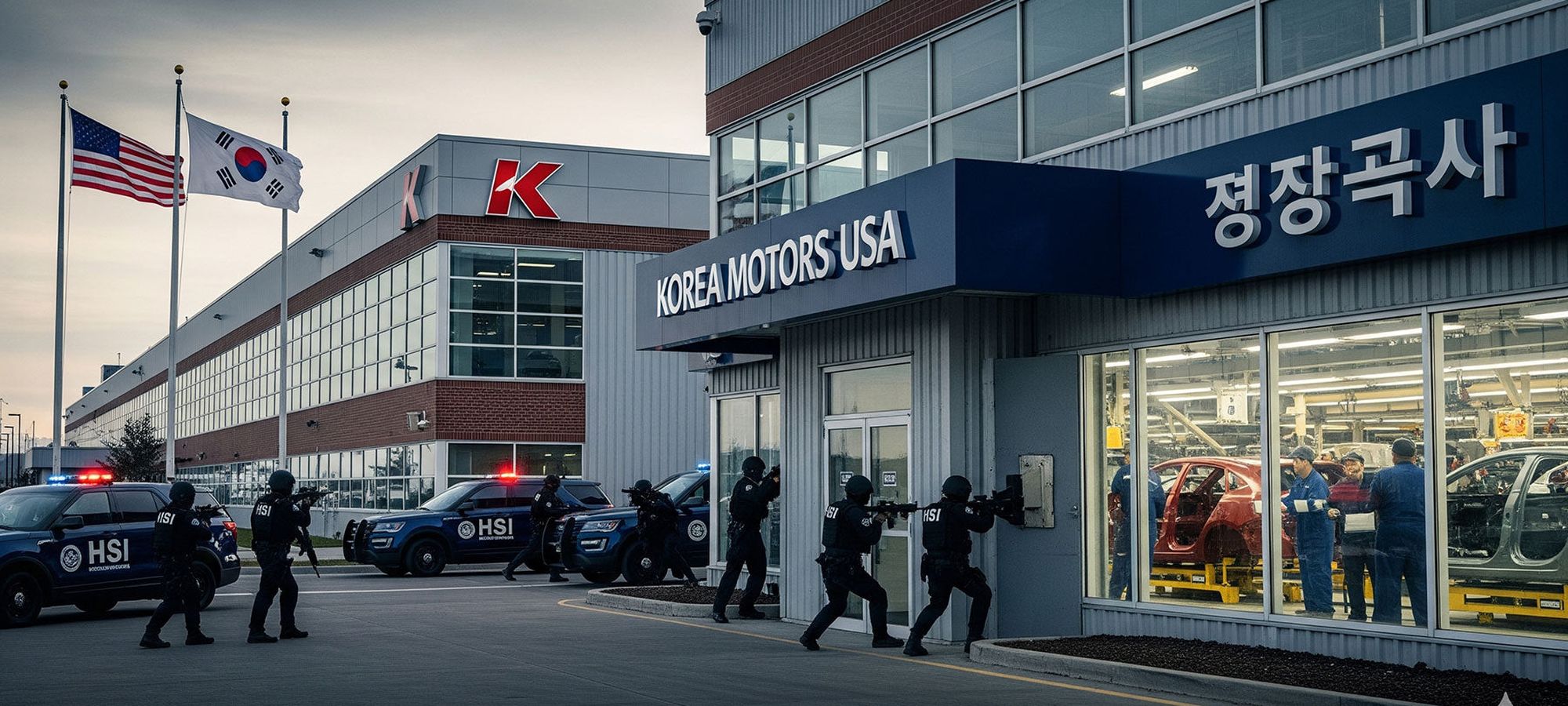
On Thursday at 6:07 a.m., the SUVs rolled in. Blue windbreakers, yellow letters. On the giant EV megasite near Savannah, Georgia, where Hyundai and LG Energy are raising a battery plant from the ground up, everything suddenly stopped. Cranes stood still, workers ran, some jumped into a retention pond, others laid their IDs on the ground and raised their hands. By the end of the day: around 475 arrests, the largest single raid in the history of Homeland Security Investigations (HSI). More than 300 of those arrested were South Korean nationals. The site: paused. The headline: global.
If you're thinking, "Those were just subcontractors, our people are only there for training, B-1, ESTA at most!", then this is exactly where the business dynamite in this story lies. The authorities allege a mix of people who entered illegally, visa overstays and people who did things on a B-1/ESTA that they were not allowed to do. Suddenly two government goals (enforcing immigration law and "Bring Manufacturing Home") collide on your plant site.
The hard lesson from Georgia
Neither your press release nor the name badges decide what counts as "work" in the US. US law does, applied by HSI/ICE, by CBP at the border and later by prosecutors and courts. "We were only there for training" won't help if day-to-day life on site looks different.
Why this affects you, even without arrests of "your own" people:
-
Subcontractor chain: anyone who comes onto your site is working on your project. Investigators now systematically examine the cascade of contractors and subcontractors. "Not on our payroll" is no shield.
-
Operational shutdown risk: one hour of HSI at the gate can mean months of construction delay.
-
Reputational and consular risk: when governments protest on behalf of their posted citizens, you've landed in a geopolitical story, not just an HR issue.
What is really allowed on a B-1/ESTA, and what isn't?
The B-1 business visitor route (and ESTA/WB as its visa-free counterpart) is narrow. Business activities are allowed, productive work is not. The State Department and the FAM (Foreign Affairs Manual) list, among others: meetings, contract negotiations, consulting, attending conferences, observation/training without productive output. Not allowed is anything that counts as "productive work": services that directly benefit a US employer, typical day-to-day tasks, performance pressure, output targets, production line or construction work.
Special case "after-sales service" (B-1): in narrow situations, a foreign manufacturer may install/service, or train US staff on, its own machines purchased abroad in the US, if the contract expressly provides for this and no US employment relationship arises. Even this is tightly limited in time and scope and no free pass for construction work.
ESTA/Visa Waiver is not a work permit. It's simply a short stay for tourism/business visits with the same narrow limits as the B-1. Productive work is off-limits.
"Training" vs. "hands-on": the red line
-
Allowed: listening, observing, receiving or giving training, as long as no productive output is created for a US entity; no line responsibility, no operational decisions on site.
-
Not allowed: operating machines, taking part in production, management roles, day-to-day project management, quality sign-offs, leading shifts/teams, construction/assembly work, in short: anything that produces output.
Employer duties: I-9, E-Verify & the "the contractor handles that" trap
Form I-9 is mandatory for every person in a US employment relationship, regardless of nationality. If you use subcontractors, you need contractual oversight rights, audits, badging rules and access controls so that no unauthorized workers do productive work on your site. "We had no idea" carries little weight when system failures are obvious.
Your 60-day emergency checklist (practical & grounded in reality)
1) Put your cards on the table.
Create a people map: who is on site? Your own staff, agency workers, subs/sub-subs? Which visas/status, which tasks? An agenda & activity profile in writing for each person.
2) Untangle the activities.
Strictly separate "permitted business" (meetings/training) from "productive work" (line, construction, assembly). No tools, no PPE, no output for B-1/ESTA travelers. No US email signatures with job titles ("Site Supervisor") for visitors.
3) Make your documents watertight.
-
Invitation letters with a precise description of purpose (meetings/training), duration and cost coverage (expenses only).
-
Training plans: "observe/shadow" instead of "operate".
-
Have no-work acknowledgments signed (visitors & supervisors).
-
After-sales service: only if the contract supports it, and document it precisely.
4) Access & badging.
Visitor badges in different colors, no access to production zones without an escort, no shift planner access, no tool checkout.
5) Seal the subcontractor cascade.
Flow-down clauses on immigration compliance, audit rights, indemnity, on-site checks and immediate replacement of personnel when status is in doubt. Monthly field audits with photo documentation.
6) I-9/E-Verify hygiene.
Where an employment relationship exists: complete I-9 records, E-Verify as required by state law/public contract terms, retention & remediation following ICE guidance. Training for HR/foremen: check documents, but don't discriminate.
7) The right visas for real work.
If tasks are productive, you need work visas (e.g. H-1B, L-1, possibly E-2/E-1 with the right structure, TN for Canada/Mexico). B-1/ESTA is then not an option.
8) Dawn raid plan.
Name incident leads, set up a legal hold process and lines of communication, no obstructive behavior, orderly ID checks at the gate, a document room for agents. Train your managers: what to say and what not to, no false statements.
Common misconceptions, straight from practice
-
"He's paid from Korea."
Irrelevant. What counts is the place and nature of the activity, not where payroll runs. -
"Only here for two weeks."
Duration ≠ legality. Two weeks of productive work are two weeks of illegal work. -
"Training means letting them work."
Training ≠ output. If you turn the wrench, you're producing. If you observe/explain, you're not. -
"The contractor's problem, not ours."
When your site stands still, it's your problem. Investigators read contracts and pursue every tier of the chain.
What you actually risk, and what you can gain
Risks:
Operational standstill, delays costing millions, contractual penalties, civil/criminal consequences (harboring/document fraud), exclusion from incentive programs, consular headwinds for future visas.
Opportunities (if you act now):
-
Predictable mobility: clear paths for meetings/training (B-1/ESTA) vs. productive assignments (H/L/E/TN).
-
Robust supply chain: subcontractor compliance as a competitive advantage in tenders.
-
Faster border processing: clean documentation reduces secondary inspection.
Our advice: put three layers in place now
-
Policy & training: a clear, two-page on-site policy beats 40 pages of legalese. Every manager must know the red line.
-
Visa design & roadmaps: a role catalog (meeting/training vs. productive), visa matrices, pre-travel clearance.
-
Controls in the field: badging, access, weekly walk-throughs, audit photos, sub-sub verification.
Georgia was a thunderclap. Anyone who now says "That could never happen to us" is playing Russian roulette with construction sites, supply chains and brand value. Anyone who says "We'll get this right" builds not just factories, but trust.
Want your US projects set up on solid legal ground, without your blood pressure spiking at the next HSI press conference? We'll work with you to build a practical mobility and on-site compliance system in 10 days, tailored to your supply chain. To see which mistakes you risk when entering on an ESTA instead of a work visa, read our article ESTA or work visa; you'll find more articles under News.
Consultation & implementation
If you'd like to find out what this means for your own situation, the best step is to book a consultation.